Povežite se sa nama

IN ENGLISH

PUTIN’S HAWKS AND THE ECONOMIC CRISIS IN RUSSIA: Kremlin’s Desperation May Become a Threat to Europe

Objavljeno prije

na

Secretary of the Security Council of Russia Sergey Shoigu said in his speech at the First Moscow Forum on International Security, which finished its work on May 29, that the EU has turned into an aggressive military block. It regards Russia as the main enemy of Europe and its leaders has already started to prepare the population of the European countries for the war against Russian with the help of a propaganda campaign.

Head of Foreign Intelligence Service of Russia Sergey Naryshkin added that “drums of war” can be clearly heard in Europe and it is going to become once again the center of the confrontation, which can lead to a new global conflict. The EU does not want to be a political union based on the economic project any longer. It wants to become a military alliance aimed against Russia, and Britain, according to Naryshkin, is putting a lot of efforts to incite war between the EU and Russia. State Secretary of the Security Council of Belarus Alexander Volfovich agreed with the Russian foreign intelligence chief and told for certain that the EU is planning to launch a war against Russia and Belarus in 2030.

There were more than two thousand participants from more than hundred countries at the Moscow Forum. Such crowds are gathered not to discuss challenging questions, but to be informed on the organizers’ approach to the most significant matters. Two Russian high ranking politicians, who have a serious influence on national strategy (or to be exact are trying to preserve such influence),  have announced that Russia considers the EU to be the main enemy. And Moscow is certain that the situation is perceived the the same way by the EU leaders.

It means that at least an influential group in the Russian government to which Shoigu and Naryshkin belong, wants to continue the conflict with the EU, regardless of the development of the war with Ukraine. It can be dragging on, or be stopped by the truce, but the confrontation with the EU will go on, because the EU has become a threat to Russia, and there is a great danger of war between them.

Former president of Republika Srpska Milorad Dodik confirmed in his speech the fears that impact the foreign strategy of the Kremlin, are based on solid reasons. Dodik warned that the EU can cause a destabilization in Eurasia, because under direction of Germany and Britain, it has been turning into military alliance aimed against Russia. The militarization of the EU can still be terminated, and if it is not accomplished, Russia and Serbia will be in danger.

The main conclusion that can be made out of these declarations is the importance of the conflict with the EU for the Kremlin and its allies. It seems that the Russian regime does not know how to maintain social stability without external conflict, and the political forces of other countries supported by Moscow, will lose their significance,  if the relations between Russia and the EU are restored.

It means that the situation has changed a lot in last two years. Then the Ukrainian government was declared to be the main enemy of peace and stability in Europe. The EU was blamed in acting against European interests because of the support it provided to Ukraine. It was rather convenient both for the Kremlin and its European allies, because it allowed to lose the slogan of reconciliation between Russia and European countries for the weakening of the EU. But now Ukraine is described by Russian propaganda not as a malicious villain, but rather as a victim of heartless Britain and treacherous Germany.

The confrontation with the EU is required to preserve the image of the external threat, which became the main tool of preventing political protest, if the war with Ukraine is ended. But in that case, there are two questions, that should be answered to forecast the development of the internal situation in Russia.

Why the Russian government has started to consider an opportunity of ceasefire or truce without achieving obvious military success? There can be little doubt that it would allow to increase the public support and ensure social stability without the external conflict.

And if the Kremlin can count on success in its conflict with the EU? It seems difficult to even to imagine that the EU can be undermined from within by the Russian political allies, which are losing their  positions. But it can be easily predicted that Russia would suffer severe damage, if the real military conflict with the EU breaks out.

The answer to the first question seems to be quite easy. The Russian government has to acknowledge that the war cannot be won. And the reason for that is not even the situation on the battlefield, which has worsened for Russia, because Ukraine gained an advantage thanks to the superiority in drones. Russian forces can counterbalance the dominance of Ukraine’s striking drones, which in contrast to Russian ones can use Starlink, by producing much more drone interceptors and anti-aircraft turrets.

Even taking into consideration the ineffectiveness of the Russian war-industry management, it can be supposed that this goal could be achieved in a year with the resources that are spent on weapons production.

However, the fact is that Russian economy does not have that year, because it is on the brink of deep crisis due to the lack of investments in all the fields, except those that connected with the war efforts. The high oil prices cannot solve this problem, because all the tax revenues from oil exports are immediately swallowed by the war-machine. Of course, the US war with Iran helped Russia to avoid financial collapse. Nevertheless, the state of economy has been deteriorating.

Russian president Vladimir Putin is not ready to admit that there is no chance to stabilize the economy without cutting military expenses. But he seems to be under constant pressure. The leading Russian economists, closely connected with the government, warn that Russian economy has entered into crisis and is passing the point of no return. Even the pro-government association of small and medium enterprises “Opora Rossiji”, which always demonstrated its loyalty to Putin, published an alarmist report filled with fears of impending crisis. It is stated there that during the recent months, production costs have been growing and the consumption has been falling. Due to the limited demand, the prices cannot be increased to compensate the expenses. Raising taxes have made the tax burden too heavy for most of the enterprises and economic activity will continue to decline.

According to the report, significant portion of enterprises are faced with a choice: significantly raise prices or exit the market. However, the decline of demand is less serious problem than the high tax burden and a high key interest rates. Because there is no chance of government support in the current circumstances, 26% of surveyed entreprises have already started to reduce personnel, because they do not see any other way for survival.

The economic situation has been deteriorating only since December. And the speed of the negative changes has been constantly growing since March, in spite of an increase of oil prices. So it can be easily foreseen that more people, who are employed in the fields not related to the war, will lose their jobs. The consumption will keep falling. The prices will be rising, regardless of all government efforts to keep them under control. Social expenses will be cut even if the oil prices remain high. And if this trajectory is not changed, in a year there will be a widespread social disturbance in Russia, regardless of the situation on the battlefield.

Vladimir Putin seems to expect that the strategy carried out by colonel-general Alexey Sedov, who is in charge of Service for the Defense of the Constitutional System (in other words for preventing political opposition) of the Federal Security Service. Sedov is trying to disrupt communications through messengers, which are not controlled by the government, and  scare off those who are seem to be too free in their public behavior. One of Moscow courts on May 27, condemned a 27-old woman to three years in prison for a picture of a kalian made out of Easter cake (in Russia it is one of the main symbols of Easter along with colored eggs). A military court in Volgograd on June 2, condemned a 34-old man to five years in jail for comments in support of Ukraine. Jail terms for pictures or comments posted in social networks have become rather common, since Sedov has increase activity of his service two years ago. A person should be frightened to post or share anything, if it is not obvious that such words or images are allowed by the state.

Putin started their service as a state security officers in the middle of 1970s and Sedov                          in early 1980s. The Soviet government of that time tried to prevent social discontent by enhancing control over all kinds of public activity. That strategy failed, the social unrest became widespread, first of all, due to economic problems. But for a security officer, who was not taking decisions but performing orders, could seen the reason of social collapse in the excessive leniency of political leaders. However, there is no doubt that the Russian president will have to acknowledge that the economic crisis, caused by the war, will make impossible its continuation, regardless the level of restrictions.

Military operations in Ukraine will be substituted by the political confrontation with the EU, which will allow to diminish the pressure on Russian economy and aver further reductions in expenses on social needs.

But what then?

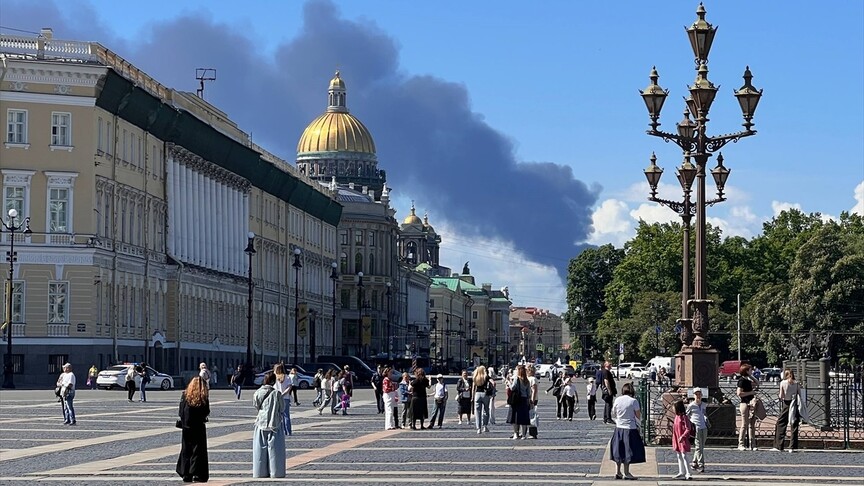
Putin lost the chance to terminate the hostilities on the actual front-line, retaining his territorial gains. It became possible after Washington had made Kyiv agree on that condition. But Putin wanted the whole Donbass, and US president Donald Trump grew tired of fruitless attempts to come to an agreement with the Russian leader. Now Trump has no need with alliance with Putin anymore. And though the leading EU countries have no desire to destroy Putin’s regime, but they want it to be humiliated. Ukraine’s drone strikes on Russian major cities and oil refineries, which bring little military effect, but a lot of images of weakness of Putin’s regime. St. Petersburg suburbs were attacked on June 3, several hours before the opening ceremony of the St. Petersburg International Economic Forum (SPIEF). The SPIEF has personal importance to Putin, who turned into the symbolic event that indicates Russian global influence. Marring the first day of the SPIEF changed nothing on the battlefield. But it revealed Russia’s weakness.

The EU is certain in the success in the confrontation with Putin’s regime and is not trying to decrease the tension in its relations with Russia or terminate the hostilities in Ukraine (in contrast with first three years of the war). The EU regards Russia as a convenient opponent. It cannot inflict a heavy damage, but can provide an image of external threat that is required for establishing common defense and military strategy of the EU.

However, it should be taken into consideration, that even humiliated and compelled to make concessions in Ukraine, the Kremlin will have to keep on confrontation with the EU, because it is essential for the regime’s political survival. Even if it is obvious, that the Russian regime has no chance for success, it will not give up. But the Kremlin’s despair can become dangerous for Europe, because Russian political allies can be used for geopolitical destabilization. Especially, if the leading EU counties decide to preserve the Putin’s regime as a convenient enemy instead of accelerating its collapse.

Dmitry GALKIN

Komentari

IN ENGLISH

RUSSIA IS SINKING INTO DEPENDENCE ON WASHINGTON: Putin is out of the big game, but he has not realized it yet

Objavljeno prije

na

Objavio:

German Gref, the CEO and chairman of the executive board of the largest Russian bank Sberbank,  stated at the annual general meeting of shareholders on June 30, that the main issue that concerns all Russians without exception is the immediate end of military operations. He added a good joke. The best way to avoid anxiety in the current circumstances, – he said, – is to stop thinking about the future. Because trying to make a forecast or develop a strategy, a person with an analytical mindset can only get into depression.

Gref can afford to make public jokes. He worked with Russian president Vladimir Putin in Saint Petersburg, where he was an important municipal official in charge of state property. He won the respect of Putin, then the deputy mayor of the city, as an economic expert. Though, Gref governs Sberbank as his own property, it is still the main state owned bank. And there are a lot of people, who would be glad to replace him, which can be easily done, if Putin feels it necessary. Nevertheless, Gref is not afraid to call for the rapid termination of hostilities at the event, which always has a good media coverage. There is only one explanation of such bravery. Gref expresses the opinion widespread in the elite circles, even among those who is close to Putin.

However, the president himself supports the opposite views. Speaking at the congress of the ruling party “United Russia” on June 28, Putin stressed that “the Kyiv regime is retreating along the entire line of contact”. On the same day, Putin in his interview with the state television declared that Russian forces will keep on fighting until they accomplish their main task “the final liberation of Donbass and Novorossiya”.

It is something new. Novorossiya, as a historical region, includes two Ukrainian largest seaside cities, – Odesa and Mykolaiv, which were never officially demanded by the Russian government previously. Besides, Kherson and Zaporizhzhia, which were claimed by Russia, are still controlled by Ukraine. There is no doubt that Putin still believes that he can capture the whole Donbas and in theory he has enough resources to accomplish it in seven or eight months. But it is hard to imagine that he can seriously contemplate besieging and destroying Odesa, a big and densely populated city. It seems that he just wanted to say that he is going to fight as long as he finds it necessary.

Russian political system is completely different from those that exist throughout Europe and resembles models widespread in Africa. There are no stable political institutions in Russia. The government, the parliament and leading political parties are just platforms for communication between the supreme power and different groups of elite, which try to influence the course of the state, but never openly oppose important decisions taken by the leader.

In such a system, one of the main obligations of the state is preventing all spontaneous actions, caused by social discontent. Because the mass social groups have no political representations, public opinion can gain influence state decisions only, if part of the elite will use it as a tool for changing state policy. In order to prolong the war in accordance with his wishes, Putin just has to deprive all the elite groups of the opportunity to utilize anti-war sentiments that are gaining popularity in the Russian society.

The top of the electoral list of the “United Russia” announced at the congress opened with Putin’s speech can be regarded as an indication that the Russian president is going to prevent all attempts to influence his decision to go on with the war. First of all, it is important that Putin rejected the advises to postpone the elections set for September 18 on the grounds of security, because Ukrainian air attacks can scare off the voters. The general outcome of parliamentary elections in contemporary Russia can be foreseen right now. But if the loyal supporters of the ruling party, annoyed and disturbed by Ukrainian air attacks, decide to abstain from voting, local authorities will face difficulties in achieving desired results. Putin showed that he is confident in his popularity and believes that his endorsement of the “United Russia” will overcome all doubts.

Chairman of the “United Russia” Dmitry Medvedev did not manage to get into the top of the electoral list, though he was reported to make efforts to achieve it. It means that he is not supposed to become the chairman of the next Duma (the lower chamber of the Russian parliament) and once more become a player with real political influence. It may be a blow to Medvedev, but the main target of this combination seems to be Sergey Sobyanin, the mayor of Moscow. Now, he is the leading political figure in the top of electoral list of the ruling party, though it is officially headed by foreign minister Sergey Lavrov. The trick is that the mayor of the city with strong anti-war sentiments became surrounded with the strong supporters of the war and will be obliged to imitate their position during the campaign. It will inevitably undermine Sobyanin’s popularity in Moscow, which has been bothering the presidential administration for quite a long time. But even more important it will make him suppress the expression of anti-war views and declare that all the inhabitants of Moscow support the President’s intention to fight until victory.

The joke appeared in the Russian capital after recent Ukrainian air-attacks: Moscow will ignore all provocations and will not allow to engage it in the war between Russia and Ukraine. It seems that Moscow will not be able to avoid an involvement, and anti-war sentiments in the capital will remain politically insignificant. It will be impossible to use them to compel the president to stop the hostilities, even if there is an elite group determined to achieve it.

But it remains unclear what Putin wants to achieve himself. He suddenly acknowledged on June 28, that no agreements were concluded during his meeting with the US president Donald Trump in Anchorage in August 2025. A few days before this statement, Lavrov declared directly opposite, complaining that the US administration does not want to carry out agreements reached by two presidents.

Putin seems to realize that Trump does not intend to give him the whole Donbas providing an opportunity to end the war looking as a winner. However, Putin cannot comprehend why Trump has changed his approach to Russia.

There is no sense to explain it by European influence on Trump or Trump’s exaggeration of the impact of Ukraine’s air-attacks on Russian economy. There is hardly a person in the world, whose opinion Trump will take into consideration if it contradicts his own beliefs. And Trump can exaggerate his role in history, but not the achievements of other political leaders.

Trump just does not need Russia any more, because his strategy has changed. He does not intend to increase pressure on China any more. He wants to control the energy supply of Europe and make concessions to China at the expense of the EU, gaining an access to Chinese to market in exchange. The US will also try to decrease its dependence on import of metals produced in China, but the direct confrontation will be avoided. Of course, China is destined to remain the only strategic rival of the US, but the main current goal of the US administration seems to be preventing the EU from obtaining a strategic autonomy. When Trump entered the session on economic security at the G7 summit with the phrase “I am the boss”, he was not joking. But the EU in its turn can hinder the US policy by enhancing cooperation with China. And Washington will be compelled to consent to it, at least to some extent.

There is no place for Russia in this scheme, which allows main global players, – the US and China, – to postpone the confrontation. Trump still can use Russia for getting advantages against both the EU and China, but in that case he needs Russia to be weak and dependent. And Ukraine’s air-strikes help to achieve that.

The Ukrainian attacks have been concentrated on oil-refineries and high-tech military production. The air-strikes are designed and organized by the American AI system Palantir. So the Pentagon can influence the selection targets. By the way, Putin still refuses to recognize the American role in the attacks and blame for them exclusively Europe (explosive parts for Ukrainian drones are supplied by Norway).

The choice of targets indicates that they are not aimed at rapid disabling of Russian forces. Neither refineries, nor the high-tech manufacturing are related directly to the main Russian advantages on the battlefield, – superiority in artillery rounds and air-bombs. When Putin says that Ukraine’s strikes cannot stop the Russian offensive in Donbas, he is not lying. But these attacks are destroying industrial equipment, which cannot be acquired by Russia without breaching American sanctions. To replace such an amount in short time seems to be completely impossible. Either if truce is established, or if the war is continued, the Kremlin is going to become completely dependent on the good will of Washington.

The change of American approach to policy towards Russia and China has already influenced the behavior of Alexander Lukashenko, the president of Belarus, who started to demonstrate that he should be regarded not as a Russian satellite, but as an independent player. On June 16, he expressed regret for being too harsh in his statements about Ukraine’s president Volodymyr Zelensky and stressed that Belarus does not want a war with Ukraine. On June 19, Zelensky demanded to switch off Russian equipment, located in Belarus, which helps to carry out air-attacks on Ukraine. Minsk gave no response, but on June 24, Zelensky announced that the equipment stopped functioning. On June 25, Lukashenko told the Russian ambassador in Minsk that his attempts to engage Belarus into the war with Ukraine are in vain, because people of Belarus have no desire to fight against Ukrainians. On June 27, Lukashenko went to meet Putin in his residence on Valdai (a beautiful lake not far from Novgorod). They spent two days in negotiations and their only result was the statement that Belarus should remain neutral, increasing cooperation with Russia. After that Lukashenko went to China where he received confirmation from Chinese president Xi Jinping that Belarus is regarded by China as a close friend.

If the peace in Ukraine is established, Belarus can become an important transit country for China, and in the current situation it will not obstruct relations between Minsk and Washington. The Balkan countries, can also gain a lot from their location on the routes that can be used by China for the access to the European market. Thanks to new technologies, Montenegro can enhance its national transit potential. Its high relief ceased to be a problem for the route construction. China built three most elevated roadways in the world. The road in the Himalayas reaches 5 886 meters above the sea level. The EU cannot allow China to control the strategically important trade routes, but it can finance their construction using Chinese workforce and technologies. Opening of the road construction in Kolashin second part of highway Matesevo-Andrijevica on June 29, proves that the Balkan countries can use for their advantage the desire of the EU to obtain a strategic autonomy and Chinese economic expansion.

Utilizing the competition between China and the US over Europe can be even more profitable. Moreover, Putin will be kept out of the game. Therefore, he will become less dangerous for the stability in the Balkans. At least until he realizes, what is happening.

  Dmitry GALKIN

Komentari

nastavi čitati

IN ENGLISH

New Trump’s strategy can be a threat to the unity of Europe

Objavljeno prije

na

Objavio:

China’s most advanced aircraft carrier Fujian, fully commissioned only in November 2025, sailed on June 23,  through Taiwanese strait on Thursday. It is the third Chinese aircraft carrier, and the first one designed by China. And it is is considered to be more powerful than two previous Russian-designed ones.

Several hours before that, Taiwan started five-day military drills aimed at training troops to fight against a possible Chinese military attack. Taiwan’s ruling Democratic Progressive Party (DPP) regards Taiwan as an independent state, and not as a part of mainland China, temporarily separated due to political reasons. A few days before the drills started, DPP Chairman and Taiwanese president Lai Ching-te urged authorities of mainland China to renounce the use of force against Taiwan and start a dialogue with the island as with an equal partner. He was answered on June 24 by Zhang Han, a spokeswoman for the State council Taiwan Affairs office, who said that China will prevent DPP attempts to pursue “Taiwan independence” and will apply force to achieve, if it becomes necessary.

Great Britain, France and Germany on June 24 issued a joint statement, in which they condemned Chinese military activities in the Taiwan Strait as a threat to the stability in the region. However, the support of the leading European countries cannot compensate the unwillingness of the US administration to make commitments to defend Taiwan in case if Chine invades the island after the proclamation of independence. Moreover, the sale of American weapons to Taiwan was officially suspended after the meeting between US president Donald Trump and Chinese leader Xi Jinping. It was explained that the US needed air defense missiles and surface-to-air missile systems, which were to be delivered to Taiwan, for the war against Iran. Though, the war was declared to be over, the 14 billion dollars (12,3 billion euros) arms sale package still has not been approved by Trump.            Lai Ching-te on June 19 expressed hope that arms purchase will be accomplished soon, but received no answer. It seems that Washington is changing its geopolitical strategy again and now  is trying to avoid any escalation in its relations with Beijing.

The US administration seems be disappointed by the fail of its pressure campaign against China, and is going to try an opposite approach and work out a mutual compromise. In such circumstances, the protection of Taiwan from a possible Chinese invasion should be regarded not as a priority, but as a “bargaining chip”, as Trump put it himself. Meanwhile, the American attitude towards Taiwanese problem was quite different not long ago.

In the “National defense strategy” published by the Department of War in 2026, it was stated that the US is going “trade and engage from a position of strength in the Indo-Pacific” and will ensure that China cannot dominate American allies. Now the US are going to pursue détente, because they wore not able to accomplish its main task, – to impose an agreement that will give the US access to Chinese market and Chinese rare earths (which is even more important). There is a conventional wisdom in Washington’s new approach to Beijing. If China’s rare-earths cannot be obtained by pressure (at least in the near future), the should be acquired through concessions.

China produces 70 percent and refines around 90 percent of the world’s rare-earths. It is a monopolist without any practical alternative. The rare-earth metals are required first of all for the production of high technology products, which has an important basic feature. The cost of raw material is insignificant comparing to the market price of a final product. China receives annually less than 3.5 billion euros from exporting rare-earth elements and magnets, and the combined value of China’s total exports of manufactured and industrial goods reaches 3.5 trillion euros. China can lose all the revenues from rare-earth exports without any economic consequences. But this export is important tool of influence that prevents any attempts to influence Chinese economic and foreign policy, because without Chinese rare-earths most of the high-tech manufacturing in the U.S. will be  disrupted and the damage inflicted on the U.S. economy will be estimated in the hundreds of billions. 

Trump started his economic conflict with China in the spring of 2025 by restricting access to the US market with high and demanding concessions in exchange for their decrease. The EU agreed on the trade deal on Trump’s conditions in the similar situation, but China restricted rare-earth metals exports in response. Within weeks, U.S. supply chains started to collapse. Ford ceased making some models due to shortage of rare-earth magnets, and even production of Tomahawk cruise missiles became threatened. The Trump administration diminished tariffs in exchange for a suspension of the Chinese rare-earth restrictions. In January 2026, Washington  eased regulations on the export of Nvidia chips to China in order to retain access to  rare-earths. Though, the concessions in the US export of the advanced products and technologies undermine the strategy of attrition, which was carried out under both the Biden and the Trump administrations and aimed at containing China’s technological development. So the US administration decided to solve the rare-earth problem by shifting its strategy towards Beijing from long-lasting confrontation to gaining control over maritime trade routes essential to China and Chinese oil-import in order achieve immediate results.  

The first step in this direction Donald Trump made, when he ordered the capture of Venezuelan President Nicolás Maduro in January. After the Trump administration had become certain that the new regime would terminate oil-export to China, it eased sanctions on Venezuelan oil in March. But before that the U.S. and Israel launched on February 28 war against Iran. The US administration wanted to disrupt the supply of Iranian oil to China and establish control over maritime traffic through the Strait of Hormuz, vital to Chinese oil and raw chemical imports. But Tehran derailed American plans. It managed to close of the Strait of Hormuz in the opening days of the conflict, inciting a rapid growth of oil and LNG prices. Approximately half of China’s crude oil
imports and one-third of its LNG imports transit the Strait
of Hormuz. But China proved to be prepared for the US attempts to disrupt its energy supply chains. China has built up huge strategic oil reserves and made a great progress in electrification of its transport and industry.  Of course American producers benefited greatly from high oil prices, but because the US is firmly tied to global markets, households and energy-dependent industries suffered a lot. Washington faced the threat of a domestic social discontent, decided to cease trying to win the economic conflict with China and hastened to make peace with Iran.

It can be surmised that the new strategy of the US administration will be limited to avoiding unnecessary tension in the relations with China and seeking new opportunities to obtain leverages over Chinese foreign trade and economic policy. There are no doubts, that Washington can work out methods to solve this problem. It can increase the American role in the global financial system. It can also enhance American influence in the Middle East in order to make countries that supply oil to China and control important trade routes more reliable on the US. Through implementation of the peace agreement with Iran, the US administration can obtain what it failed to get by force. Supreme leader of Iran Ayatollah Ali Khamenei, who was killed in late February, was propped up by the Islamic Revolutionary Guard Corps (IRGC) and helped the IRGC to increase its foreign and domestic influence in his turn. His son Mojtaba Khamenei, whom he never regarded as his successor, will not be able to provide the IRCG with the comparable political assistance. Besides, some of the political leaders, who were in favor of expansionism, have been assassinated via targeted air strikes. So the IRGC will be concentrated on fighting for power inside the country, and not on foreign affairs. And the US collaboration with the Iranian regime will not be regarded as a threat by the Gulf countries. Moreover, both Iran and its rivals can gain profit from Trump’s desire to secure the US global energy dominance. At least Quatari government seems to expect it, as it can be concluded from its gift to President Trump. The luxury Boeing 747 plane, which is worth approximately 350 million euros arrived on June 19 to base Andrews in Maryland.. 

The main threat to the US is that it may loose its strategic allies in Southeast Asia, trying to deal with China without consideration of their interests. Vietnam seems to be particularly scared that it will be left without American support in the face of Chinese expansion. In the end of May President of Vietnam To Lam told the press that American presence in Southeast Asia is necessary to counterbalance Chinese influence.

But there is also a potential threat to the global stability that can even bring the US administration tactical advantages. It is a probable fragmentation of Europe. In the current situation, strong and united Europe can become an obstacle for the US strategy. First of all, because the euro is the main rival to the dollar, and unchallenged dollar domination of the global trade and financial system can become an effective leverage on China. The euro is the second most used currency in foreign exchange transactions. Central banks keep 20 percent of their reserves in in euros, international debt issuance in euros has surged recently, and the US will not be able to turn the dollar into a weapon against China, if there is another widespread and stable global currency.  President of the European Central Bank Christine Lagarde said that the digital euro project, which will inevitably reduce the dominance of the US dollar, should be regarded as “a political statement concerning the sovereignty of Europe.” But it seems to be that the EU does not know, what it is going to do with the sovereignty or how it should be protected.

First of all, there is no comprehension what are the geopolitical goals of the EU and if they are different from the European countries, which are not included in the union. Now, the European police is influenced mostly by the countries, – Britain, France and Germany, – which are trying to coordinate their efforts, but often do not take in the account the opinion of less powerful. The EU countries that have their own geopolitical ambitions do not want to comply with such practice. Poland’s foreign minister Radoslaw Sikorski on June 23, urged the British government to rebuild its military and meet Nato defense spending commitments. Sikorski warned that the UK’s influence will wane, if it cannot back up its diplomacy by force. 

Sikorski’ demands establishing the European political system, in which those who want to lead will have to put more efforts than others into enhancing the common security. It such system is not created, some of the European countries will start to prioritize their mutual relations with the US over their commitments to the EU. In that case, the fragmentation of Europe will become inevitable and the competition between European nations will soon reach the level comparable to the one before World War II. 

The Balkans countries, which can be compelled to choose different sides in such circumstances, cannot ignore the probability of such development. They have to work out common strategy, which will allow them to ensure their common energy security and avoid economic conflicts, in spite of competition between the US and the EU and rivalry between European countries. And Montenegro, which is not regarded as an enemy or a threat by any country of the region, can play a leading part in the preserving stability and cooperation on the Balkans.    

Dimitry Galkin

Komentari

nastavi čitati

IN ENGLISH

WAR AND TRUCE IN THE GULF: Turkey profits from American ambitions and EU weaknesses

Objavljeno prije

na

Objavio:

The Memorandum of understanding between the US and Iran suggests that the US in the coalition with the countries of the region will “develop a definitive, mutually agreed plan for the reconstruction of the Iranian economy. The combined investments that should be at leas USD 300 billion (260 billion euros). The US will be also obliged to remove all the sanctions that restrict the export of Iranian crude oil. It will be achieved, when other parts of the agreement are implemented. But until the complete termination of sanctions, the waivers for export of oil and petroleum products will be issued by the US Department of Treasury.

Therefore, the points of agreement with Iran will allow Washington to gain some control over the Iranian economy, and particularly over important industrial and  infrastructure projects, which will be carried out by the US and its allies in the region (obviously, it will be mostly Gulf countries). The US administration will also get an influence over Iranian oil-export, which is going to become more profitable thanks to American waivers. And import of Iranian oil will become less beneficial for China.

Maybe, it is less than US president Donald Trump wanted to obtain, when he launched the war of Iran. However, the agreement he managed to reach with Iran, can be regarded as his victory. But for the future of international relations, it is more important that this agreement is a complete  disaster for Israel. There is no doubt, that it will impact the media perception of the memorandum. Still the Israel’s failure should not overshadow Trump’s success. It should be acknowledged that for the first time since Suez crisis of 1956, the US made a peace agreement, regardless of the Israeli interests. Israel has frightened the Gulf countries by its pretensions for the regional dominance and achieved almost nothing. Even Hezbollah, the main enemy of Israel in the region, was not defeated, though significantly degraded. The Iranian military might has been seriously diminished, but if the deal between Iran and the US is implemented, Tehran will have an opportunity to restore relations with the Gulf countries and establish cooperation with the US. And it is more dangerous for Tel Aviv than Iranian missiles, which can hardly breach the Israeli air defense system.

Maybe, only Russia lost more than Israel. It did not dare to betray Iran openly, but did not provide it with military support in order not to irritate Trump. However, the US president can appreciate only actions of loyalty. It is more important that he does not need an alliance with Russia any more. He failed to create effective leverage in negotiating with China and due to that the position of Russia does not matter much to him now. Meanwhile, the Kremlin has shown a strong desire to become a partner of the incumbent US administration. China could not feel disappointed, because Beijing might have expected such an approach from Russia in spite of  declarations of  an extraordinary friendship. At the beginning of the war in Ukraine, Russia expected significant investments and military support from China. But Beijing has not exceeded the level of mutually beneficial trade relations. Parliament Konstantin Zatulin on June 16 declared that China cannot be regarded as an ally of Russia, because it uses Russian economic difficulties instead of assisting in overcoming them and sells drones both to Russia and Ukraine.

Of course, Russian financial system benefited from high oil prices benefited with the high oil prices, caused by the war. But it should be taken into consideration, that after Trump had lifted restrictions on Russian oil-export in order to decrease fears of an oil deficit, Ukraine was provided with American “Hornet” long-range strike drones and AI tools of Palantir Technologies adopted by the Pentagon. It allowed Ukrainian forces to strike Russian refineries, pipelines, oil-ports and terminals that significantly diminished oil-export amount and revenues. It is touching how the Russian government persistently ignores the American role in the destruction of Russian oil-industry, but it seems to be of no help. Trump promised on June 16 that restrictions on Russian oil-export will be reimposed. So the increase of income will come to an end soon, and the demonstration of weakness will have long-lasting repercussions for Russian     international standing.

In contrast to Russia, Turkey was able to use for its benefit both Trump’s ambitions and Iranian resilience. Turkish president Recep Erdogan managed to demonstrate the strategic autonomy of Turkey by his approach to the war between the US and Iran and to Israel’s military activity. He did not damage his relations with Trump, but at the same time managed to show that strong Turkey should be regarded as a counterbalance both to American ambitions and Israel’s desire to dominate in the region.

Thanks to that, Saudi Arabia, which was one of the main rivals of Turkey, decided to shift from confrontation to partnership. The both countries signed an agreement on developing a new international railway corridor connecting the Gulf countries to Turkey through Jordan and Syria.

Saudi Arabia organized a coup aimed to overthrow Mohamed Morsi, who was supported by Turkey in 2013. In 2020 Turkey helped to defeat general Khalifa Haftar, who was trying to capture Libyan capital Tripoli with support of Saudi Arabia and Russian Wagner Group. In that battle the impressive capabilities of drones produced by Selçuk Bayraktar (Erdoğan’s son-in-law) were demonstrated on the battlefield for the first time.

The reconciliation has become possible, because thanks to the US and Iran, Saudi Arabia and other Gulf countries realized that they need a land route, that can be used as an alternative to the Strait of Hormuz.

For Turkey, it is not just an opportunity to increase its transit potential. It is restoration of the historic transport link between the Persian Gulf and Europe. The similar railway was built in the  the Ottoman Empire at the beginning of the 20th century, but after its collapse, the connection was interrupted and the railway soon fell into disrepair. Building of the railway will also strengthen the Turkish presence in Syria, at the end of 2024 the political forces oriented on Turkey came to power. Moreover, Saudi Arabia and its allies will cease to regard Turkish presence in Syria as a potential threat and might take part in the  reconstruction of Syria, helping to establish social stability there.

The railway line from Saudi Arabia through Jordan and Syria to Turkey will be connected to the European rail network. Minister of transport and infrastructure of Turkey Abdulkadir Uraloglu told Al Jazzera on June 15,  is planned to be used to transport oil and natural gas to Europe. According to the Turkish minister, the railway line will help alleviate in future the problems to shipping, caused by the blockade of the Strait of Hormuz due to military conflicts.

If these plans carried out, the EU is going to receive a new supply route, controlled by an ambitious country, which in the current situation has no need to take the EU interests into consideration. In his speech on May 9, devoted to the prospects of Europe, Erdogan said that “a European architecture” without Turkey would “remain incomplete and vulnerable in managing crisis”. The Turkish candidacy for the EU was frozen in 2018, which became a personal blow to Erdogan, who always tried to persuade the Turkish voters that his political Islam can be compatible with pro-European aspirations. He came to power 23 years ago, promising to make Turkey a member of the EU. From that point of view, a semi-authoritarian regime built by Erdogan, can be regarded as a failure of European leaders. Erdogan would not be able to do that, if Turkey had been integrated into the EU. Moreover, undermining of democratic institutions became for Erdogan the only way to stay in power, after Turkey’s attempts to  join the EU were blocked.

According to Erdogan, the EU’s need for the Turkey “exceeds Turkey’s need for the bloc, and this need is expected to grow even further in the future”. Turkey’s geopolitical influence is increasing, because the ambitions of the current US administration are frightening even such strong American allies as the Gulf states. If Turkey strengthens its positions in the region, it will inevitably become for Israel even the more dangerous rival than Iran. It can be prevented, if Istanbul is compelled to comply with a foreign strategy of the EU. It does not exist yet, despite all the efforts to design it, but it should be developed, if the EU wants to achieve strategic autonomy. And an important step in this direction may become a change of the EU approach to Turkey.

At present, the EU is too week to preserve the European influence in such important regions as Middle East and Northern Africa. The EU did not even make any efforts to stabilize Syria, and that allowed Erdogan to gain contorl over the country, winning competition with Russia. Moreover, there is a danger that European Muslims can become more alienated due to growing economic hardships. Erdogan, who actively supports the conception of the united Muslim Ummah, can  alleviate this process. He can also propagate anti-European sentiments, if Turkey remains rejected by Europe. Especially, if the railway to Saudi Arabia will be used for Hajj pilgrimage of the European Muslims to the holy sites, as minister  Abdulkadir Uraloglu promised.

Dmitry GALKIN

Komentari

nastavi čitati

Izdvajamo