Povežite se sa nama

IN ENGLISH

GRENELL’S (UN)OFFICIAL VISIT TO WESTERN BALKANS: Backroom Deals in Montenegro Again

Objavljeno prije

na

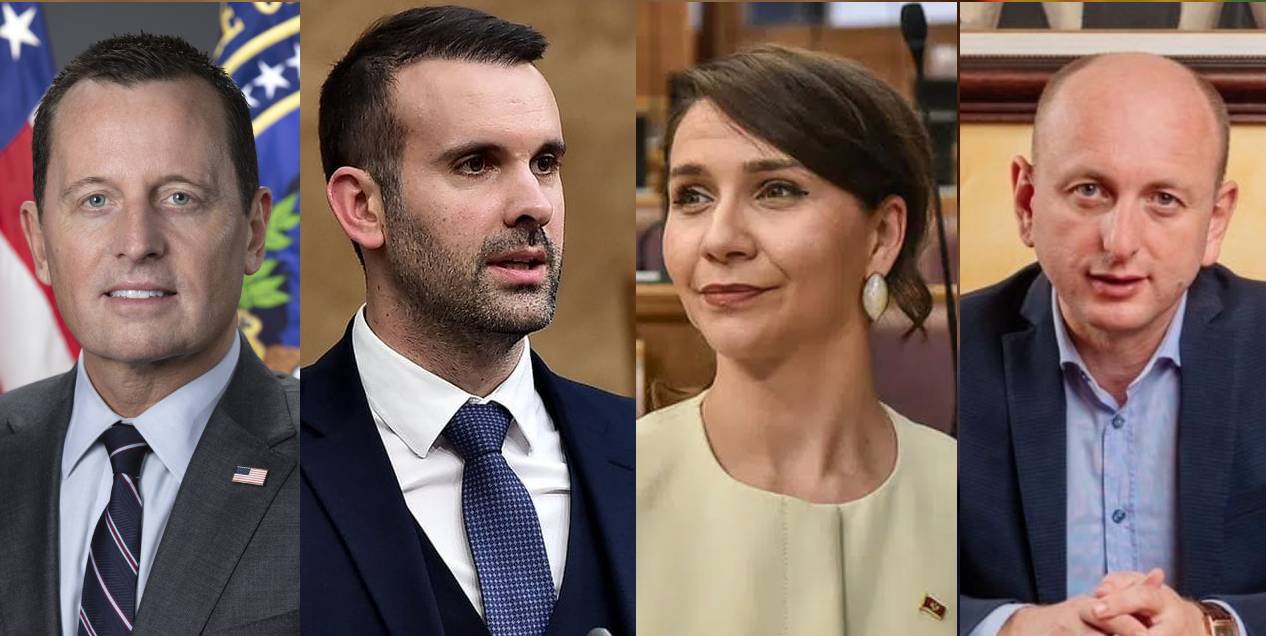
Richard Grenell, former U.S. envoy for the Serbia–Kosovo dialogue and once a powerful figure in Donald Trump’s first administration, reappeared in the Balkans this August on what was labeled an “unofficial visit.” His meetings and media appearances, however, looked suspiciously like an improvised diplomatic tour. Still, regional interlocutors who interacted with Grenell during his visit say that his vocabulary and tone sounded like that of an envoy on official mission, though he never formally claimed such a role. He even hinted, indirectly, that next year he would be back in a far more powerful position — effectively pitching himself


Last Thursday afternoon, Antena M reported that Milorad Dodik, the recently convicted president of Republika Srpska (RS), met with U.S. special presidential envoy Richard Grenell at the One and Only hotel in Portonovi, Montenegro. While authorities in Banja Luka did not confirm the meeting, it was notable that a rally organised by Dodik’s party (the Independent Social Democrats), originally planned as a protest related to his court verdict, was abruptly canceled. Antena M further reported that an unnamed Republican congresswoman was present at the meeting. No Montenegrin officials were involved or played any role in organising the encounter at the resort near the city of Herbage Novi.

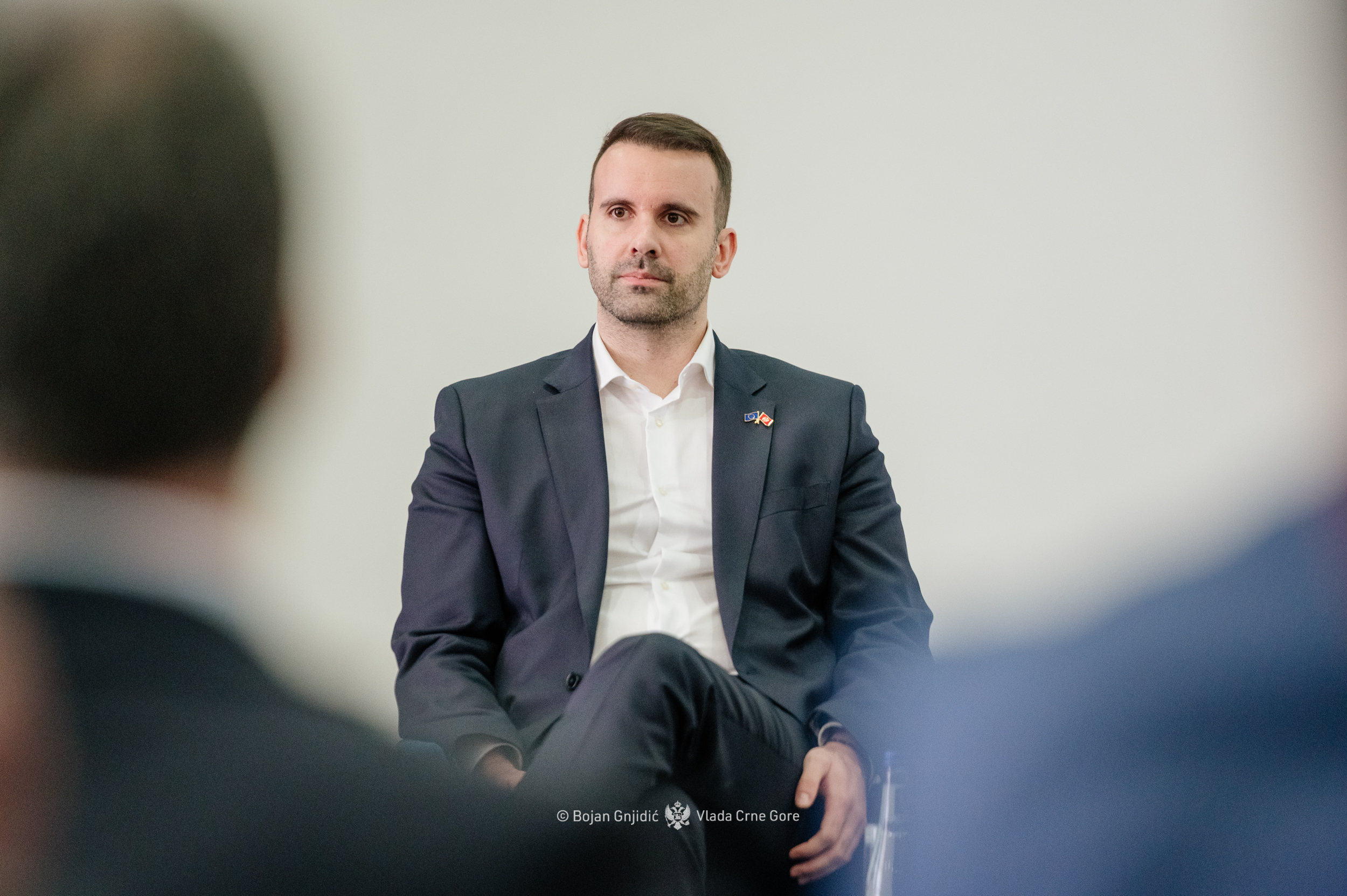
However, Monitor received information, which could not be independently verified, suggesting that Grenell also met with Montenegro’s Prime Minister Milojko Spajic and Minister Majda Adzovic on the same day. Allegedly, discussions were uncomfortable and centred around recent turbulence related to airport concession deals in Montenegro. Officials close to the prime minister denied that any such meeting took place, while Minister Adzovic did not answer inquiries.

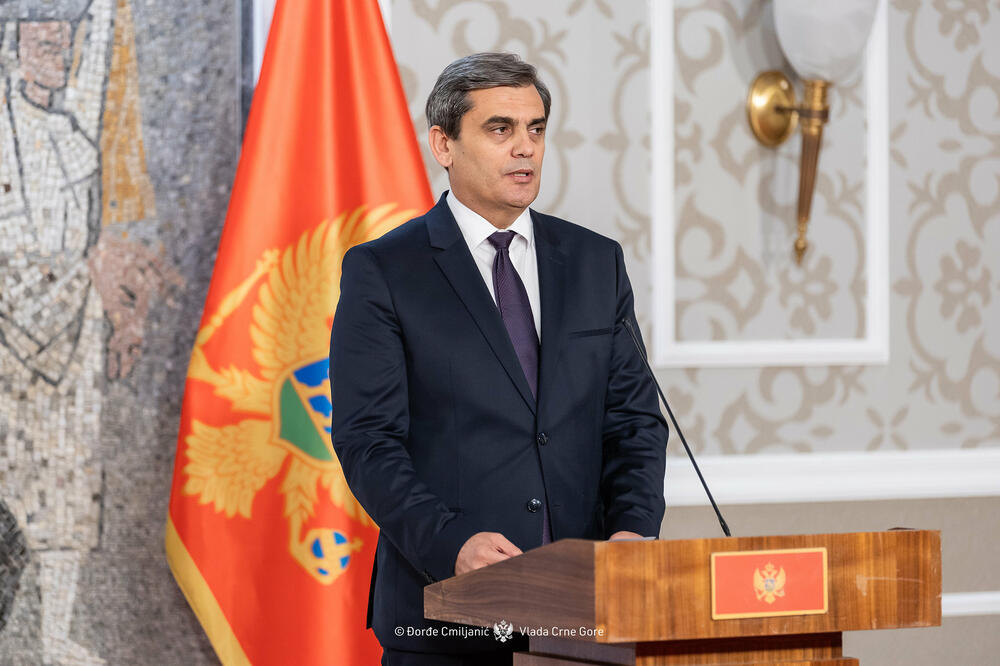
Earlier, on July 19, Nik Gjeljoshaj who simultaneously serves as Deputy Prime Minister, Economic Development Minister, and chair of the commission overseeing airport concessions informed the public that he had met with Grenell in Washington. In a statement from the U.S., he expressed gratitude to Grenell as “a great friend of the Balkan countries,” and requested support for the country’s accession toward European Union and stronger ties with the United States. During his U.S. visit, Gjeljoshaj claimed to have met in an official capacity with the FBI Director and his “senior leadership team.” Discussions were said to revolve around “the essential importance of upholding the rule of law to attract investments from Western countries and the U.S.” However, the Government publicly denied sending him and said that Gjeloshaj traveled to the U.S. privately. The Deputy PM did not provide any photographic evidence of these meetings. Before his trip, Mr Gjeloshaj was visibly dissatisfied with the tender outcome and the failure of the U.S.–Luxembourg bidder for the airport concessions that he was in favour of.

The day after the Portonovi meeting with Dodik, borba.me reported that on the evening of August 8 “in one Montenegrin coastal town”, Milan Knezevic, the leader of the Democratic People’s Party (DNP) met with Grenell. The meeting reportedly lasted nearly two hours, marked by open dialogue and exchange of of views.

The portal, considered an informal outlet of the pro-Serbia and pro-Russia “For the Future of Montenegro” (ZBCG) coalition, reported that Knezevic “detailed to Grenell the current political situation” – including internal relations in the government and various security, economic and international challenges. The interlocutors agreed “to continue communication and exchange of experiences,” with a prospect of a follow-up meeting in the future .

After departing Montenegro, Grenell continued on to Croatia. He shared on Instagram a photo of him posing with friends in the old town of Dubrovnik. The same day the Kosovar portal Gazeta Express reported that during his stay in the Western Balkans, Grenell met with Shkëlqim Devolli, a shareholder of the prestigious Devolli Corporation, founded by his father Ibrahim Devolli. Shkëlqim Devolli is a regular visitor to the U.S., often seen with influential figures like Republican senators Roger Wicker and Ted Cruz, Texas Governor Greg Abbott, and CIA Director John Ratcliffe.

Gazeta Express highlighted that the main topic of discussion was “stimulating economic growth in Kosovo through foreign investment.” It also noted that Grenell “confirmed the Trump administration’s continued commitment to supporting Kosovo and the Western Balkans,”  thus promoting peace, stability, and prosperity. Just like with Knezevic and borba.me, the Gazeta Express account carries an official-sounding narrative, with the identical promise that the parties will “continue the dialogue and explore concrete ways to implement joint projects that would bring sustainable economic benefits and strengthen U.S.–Kosovo relations.” Although the location of the meeting was not disclosed, according to Monitor’s information, Grenell visited the Albanian seacoast prior to coming to Montenegro. In Albania he held a series of meetings with government officials and gave an interview to Klan Kosova – published on August 9.

Allegedly, Grenell was also seen in the region with Serbian Minister of Finance Sinisa Mali. It’s worth recalling that at the end of October 2023, Serbian President Aleksandar Vucic awarded Grenell the Order of the Serbian Flag, First Degree, for “outstanding merits in developing and strengthening peaceful cooperation and friendly relations between Serbia and the United States.” A similar decoration had been awarded to him by Kosovo three years earlier.

Still, the meetings with Albanian officials were not publicized—partly due to uncertainty over Grenell’s status, as he is on poor terms with key figures in President Trump’s administration—Secretary of State Marco Rubio and Trump’s chief of staff Susie Wiles. Grenell’s great influence during Trump’s first mandate is a thing of the past, at least for now, according to U.S. press reports. His actual job at this moment is acting director of the John F. Kennedy Center for the Performing Arts.

Regional interlocutors who were in Grenell’s circle during the visits say his vocabulary sounded as if he were on an official mission, even though he never formally said so. He also indirectly suggested that next year he would hold a significantly higher position than now, thus pitching himself in the region.

When asked whether Grenell was acting in an official capacity in Montenegro and whether it had mediated the meeting with Dodik, the U.S. Embassy in Podgorica referred Monitor to the State Department’s European desk. After the same inquiry, the State Department replied that Monitor should contact Grenell’s office directly. No response arrived prior to this publication. Unofficially, Washington sources told Monitor that the State Department had nothing to do with Grenell’s regional visit and that he was acting as a “freelance”.

Regardless of Grenell’s current status or his career’ trajectory, a big question remains as to how prepared Montenegro is for increasingly unpredictable international relations. So far, bilateral relations between Spajic’s government and the United States have not been impressive. A week ago, U.S. Secretary of State Rubio received Serbian Foreign Minister Marko Djuric—formerly Serbia’s ambassador in Washington, who built a strong Serbian caucus in the U.S. Congress. Rubio announced a “strategic dialogue with Serbia” for the end of the year. This is a process the State Department often carries out to strengthen bilateral relations. It entails high-level discussions on a wide spectrum of topics—defence, security, energy. Djuric emphasized that Serbia requested U.S. government support for issues important to Belgrade, and that his trip to Washington was significant for repositioning Serbia with the new administration. There’s no doubt that Montenegro is on Serbia’s top priorities list.

From the Montenegrin side, however, the current ambassador to the U.S. and the government seem largely indifferent to the disappearance of the Montenegrin caucus and show little effort in building strong ties with Trump’s administration. Previous head of mission in Washington, Nebojsa Todorovic, repeatedly briefed the government and foreign ministry well before the presidential elections that Trump’s return was inevitable and to prepare for it. Even President Jakov Milatovic’s visit to Ohio for the NATO Parliamentary Assembly meeting in Dayton (23-26 May), to mark 30 years of the Dayton Peace Agreement, was poorly prepared. Neither the embassy nor the foreign ministry knew that the U.S. state delegation would only be present on the first day in Dayton. Only thanks to intervention by the former ambassador did Milatovic’s delegation arrive a day earlier. That paved the way for Milatovic’s meeting with Deputy Secretary of State Christopher Landau—which, at such a gathering and outside the capital, carried considerable significance. Similar mistakes by the foreign ministry, ambassadors, and chargés d’affaires have also occurred in European capitals, with serious oversights about dates and availability of European officials.

The lack of serious diplomatic effort and narrow party interests could cost Montenegro dearly. Neighbouring countries, more skilled in lobbying, may shrewdly exploit this for their own interests—which are often at the expense of Montenegrin interests.

Jovo MARTINOVIĆ

Komentari

IN ENGLISH

AFFAIRS IN THE UKRAINIAN TOP: Who is Forest and where he has to run

Objavljeno prije

na

Objavio:

Ukraine’s High Anti-Corruption Court on August 25, decided to suspend pre-trial detention of Oleksiy Stupak the Chairman of the state-owned Sense Bank due to his poor health. A day earlier, Iryna Mudra, the deputy head of president’s office arrested under the same investigation conducted by the National Anti-corruption bureau of Ukraine (NABU) was left in custody until bail of 20 million hryvnias (390 000 euros) is paid. The comparatively low amount of the bail for Mudra and the consideration of Stupak’s health condition were interpreted by many Ukrainian journalists as a sign that they both agreed to cooperate with the NABU. And there are good reasons to believe it.

Stupak, Mudra and several other civil servants and entrepreneurs were accused in laundering money collected to pay the bail for Herman Halutshchenko, who served first as the Minister of Energy and then the Minister of Justice. He was detained on February 15, and the bail for him is 150 million hryvnias (2,9 million euros). Because all money that belonged to Halutshchenko and his family was frozen the NABU started a new operation in order to find out how the money would be collected.

The phones of those who can be involved in the releasing Halutshchenko out of jail were wiretapped, and the NABU has already published some of the intercepted conversation. The NABU called this operation Forest Gump. The most popular explanation of such a name is that it was used for Halutshchenko by one of this participants of laundering scheme. Talking about the difficulties caused by the freezing of  assets belonged to Halutshchenko, he said that only mentally retarded person could set up a trust for some of family expenses and transfer in it the money gained from corruption schemes. So laundering the money for his bail should be called “saving Forest Gump”.

However, influential political journalist Juriy Vishnevsky suggested that the name of the main character of the famous movie was used by the NABU not to mock at the former minister. He paid attention that the phrase “Run, Forest, run” is remembered by everyone who saw the movie, and comes to mind first when it is recalled. In that case, the message is clear. The person, who is  meant to be the target of the message, is advised by the NABU to leave his position. Mudra in her conversations with other participants repeated a few times that her superiors make her hurry up with  Halutshchenko’s release. There were only two people higher in rank than Mudra the president’s office. Head of the office Kyrylo Budanov and the President of Ukraine Volodymir Zelensky. It seems highly unlikely that the NABU wanted to send any message to Budanov. And there can be little doubts, that he NABU would not start such a communication without approval (or even request) of its American partners.

Mudra was arrested on August 19, on charges of  the legalization of the cash, which was brought at her disposal to be used as a bail for Halutshchenko. The main problem was that the bail could not be paid with the money of doubtful source. So they had to be transferred from account to account until their origin could be considered completely trustworthy. The bail was paid on June 29 and Halutshchenko was released thanks to the money-laundering operation carried out by the state owned bank. Moreover, when Mudra mentioned in her conversations with the top managers of the bank the possible problems with the State financial monitoring service, she was promised that all the problems would be settled. It turned out to be true. The agency did not terminated or suspended any of the transfers, though most of them should have been regarded as extremely suspicious.

It turned out after her arrest, that Iryna Mudra is much wealthier than her legal income allowed. More than 6 million euros were found on her deposits and accounts in Ukraine and Israel. She also came to be an active investor in the construction projects and bought shares of Microsoft. She owns five expensive apartments in Kyiv, which are partially registered for her 73-year-old mother. If the two Mudra’s superiors knew nothing about that, they both should be considered dangerously incompetent.

There is no mystery in the source of Mudra’s wealth. When she was arrested at 7 in the morning, scandalously known developer and former Member of Parliament Maksym Mykytas was found present in her apartment. He has been also put in custody with comparatively law bail, just 580 thousand euros.

Mykytas has become the suspect in several anti-corruption investigation since 2019 and three of them (not counting Forest Gump operations) are still going on. He had to stay in custody for quite a long time in recent years and his former partners swindle out of his business. Mykytas came for protection to Vadym Stolar, an acting member of parliament and one of the biggest Ukraine’s developers, who prefers to live abroad. In last years of the rule of Victor Yanukovych, Stolar was considered to be a mediator between the president’s close circle and developers, who had construction projects in Kyiv, It seems that Stolar has not lost his influence, because he helped Mykytas to regain control over construction companies and sites he had owned. Mudra, as it can be concluded from the published records, has actively participated in the restoration of Mykytas’ property rights. In accordance with her last name, she gave him useful advises how to influence judges and acted on his behalf in the ministry of justice. Once, they even has a quarrel, because Mykytas did not warn her that he fabricated some of the court decisions.

It should be noted, that in the president’s office Mudra was responsible among other things for the justice reform.

But the most interesting question is why Mudra and Mykytas became involved in the scheme of laundering money for Halutshchenko’s bail. It was not related with their business interests. The only possible reason is that Mudra was compelled to do it. And here the most interesting part starts.

Halutshchenko’s arrest was one of the outcomes of  “Operation Midas”, executed by the NABU in 2025. But he was not the main target of the investigation. It was directed against Timur Mindich, a former friend and a business partner of Volodymir Zelensky, – Mindic was a co-owner of a production company, which made movies and comedy shows with the future president of Ukraine. During the war,  Mindich became the key figure in the illegal scheme of electric energy distribution. Thanks to the constant deficit, caused by Russian air-strikes, some companies were eager to pay huge bribes for the uninterrupted delivery of electricity. And the former producer managed to provide it through nuclear power plants (all of them are state-owned in Ukraine).

Timur Mindich and his friend Oleksandr Zukerman were supposed to be arrested under the warrant issued by the NABU and Specialized Anti-corruption Prosecutor’s office (SAPO) on November 10, 2025. However, both managed to leave the country on that day without being stopped at the border. It was also also found out that the some of the revenues from illegal energy distribution were utilized for the construction of elite estates. And Andriy Yermak, who served as the head of the president’s office, has been suspected in supervising this activity.

On November 28, 2025 Yermak was dismissed from his position. On May 14, 2026 he was  detained, but he was released on bail of 140 million hryvnias (2.7 million euros). He lost part of his influence recently, but preserved some of his people both in the president’s office and in the government, even after its recent reshuffle. Mudra is considered to be a trusted associate of Yermak, who seemingly had no connections with Mindic. However, Mudra carried out directions of Mindic.

It has not been proved that the money for Halutshchenko’s bail was provided by Mindic, though it is suspected. But it can be concluded from Mudra’s phone conversations that Mindic asked her to prevent the Sense Bank from falling under control of “David”. It is obvious that she meant David Arakhamia, the head of the ruling parliament faction. It can be comprehended that the Sense Bank has been washing out money from online gambling. And “David” wanted to get a share of it.

Mudra used her connections to make David’s people to behave like “cute kittens”. So the peace between the different groups in the Ukraine’s ruling establishment remained undisturbed. It can be observed that the political system created by Zelensky and his associates function without any serious problems. As it can be concluded from conversations of Mudra, the president’s office controls civil courts and top-level bureaucracy. And Arakhamia can deliver desired results of voting in the parliament thanks to his informal interactions and deals with some of the opposition groups, including former pro-Russian opposition. Serious obstacles for the smooth functioning are created by the NABU and SAPO. And Mudra discussed the ways to remove head of SAPO Oleksandr Klymenko. Last year, the president’s office made an attempt to deprive the NABU and SAPO of their independence, but was stopped by the US administration and suffered a public humiliation. The lesson seems to be learned, and the ant-corruption agencies continue to operate without restraint. They can cause difficulties and troubles for president’s associates, but they cannot change the system. It can be achieved only through elections.

On August 18, former Ukrainian Defense Minister Mykhailo Fedorov has called in his address to Ukrainians for a search for a legal and safe mechanism that would allow the electoral process to resume in Ukraine, even if the war with Russia continues for several more years. Fedorov stated that corruption remained widespread under Zelenskyy and it should be regarded as a symptom of the deep  crisis of governance. On the next day, Mudra was arrested.

Zelensky suggested that Fedorov could have been pushed to call for elections by external forces. The former minister denied this. But his plans to visit the US in the near future and raise there capital for drone production deserve attention. Meanwhile, CIA Director John Ratcliffe, who is considered one of the most ardent Ukraine’s supporters among the close associates of president Donald Trump, unexpectedly arrived in Moscow, on August 25. The goal of his visit was not revealed. But the US administration strove to disclose the Ratcliffe’s trip to Russia. He traveled by a U.S. Air Force Boeing C-17A Globemaster III transport plane that naturally attention at a Moscow airport, as a U.S. diplomatic motorcade in the Moscow streets. Moreover, ahead of Ratcliffe’s trip, the U.S. told Ukraine that a senior delegation would be traveling to Moscow and asked it to suspend strikes until the delegation’s departure. It could be expected that Kyiv would spread information about such a request that proves that Washington has high estimation for Ukraine’s military capabilities. It can also be suggested that the US administration wanted to inform Zelensky that there are negotiations between the US and Russia on the matter that remains secret to him.

It can be a good way to inform a person, who like Forest Gump has some problems with comprehending reality, that situation is very serious. And it would be better for him not to fight against necessary changed. Even if it means that he will have to leave his post.

Dmitry GALKIN

Komentari

nastavi čitati

IN ENGLISH

USA STUCK IN THE GULF: Trump’s failed attempt to cover up defeat

Objavljeno prije

na

Objavio:

The war, according to Trump’s expectations, was supposed to be over in a few days and bring American control over Iranian oil exports and influence over China. It increased China’s global influence, strengthened Iran’s international position, depleted US missile stockpiles, which indicates American strategic weakness. If Trump fails to perform a miracle and win a war that seems lost, this conflict could open a new chapter in world history. Not so favorable for the US

On August 10, British Chelsea women’s football club announced on its account on the social network Threads to include in their profile the comment to the post that would gain most likes. In several days, it became clear that the top comment is “Free Palestine”, which received 136 thousand likes. The club did not make the top comment part of its profile, as it had been promised. Instead, the comment was deleted alongside with the entire post.

On August 18, the Ministry of the Interior of the German federal land Hessen banned  the anti-Israel association “Palestine e.V.” It was accused of spreading antisemitic propaganda and its storage facilities were searched by the police.

These two events can be regarded as evidence that the support of Israel can create problems in such different European countries as Britain and Germany. It triggers confrontation between football club management and its fans, increase activity of radical groups, undermine public trust in political institutions. But neither Britain, nor leading EU countries can abandon support to Israel, because they have no real alternative to their traditional strategy. Though, the UK and the EU have moved toward a more critical approach to Israeli’s policy, they cannot condemn it and compel Israeli’s government to change it. The US administration has significantly less freedom in this aspect. It is much more engaged in the conflicts in the Middle East than any European country. Washington has been trying to establish control over the region using assistance of Tel Aviv. If Israel was strategically weakened, the American influence in one of the most important global regions would be irreversibly diminished. So the US administration cannot end the war with Iran, because one of the main Iranian condition is the termination of the hostilities on all fronts, including Gaza Strip. And Israeli government wants to keep at least part of Gaza under occupation under the pretext of threats to national security.

Officially, there is a ceasefire in Gaza, brokered by the US in October 2025. However, it has been violated by the both parts. But most important is that no agreement on permanent truce can be reached, until Israel preserves its military presence. And Israel has no intention to leave Gaza. Moreover, Israeli Security Minister Itamar Ben-Gvir said in a podcast on August 16, that he considers all of Gaza to be a part of Israeli’s territory. Ben-Gvir is confident that Israeli troops should stay in Gaza and keep killing Palestinians, at least 30 or 40 per night. All who can pose a threat must be targeted, even if they are not militants, because  there are people in Gaza who don’t deserve to live.

Prime minister of Israel Benjamin Netanyahu needs an alliance with far-right parties. So he will not willingly remove Ben-Gvir and those who share his opinion from the government. Therefore, a peace agreement on Gaza Strip seems to be almost unreachable. However, US president Donald Trump is making efforts to achieve it. His son-in-law and the White House special envoy for peace Jared Kushner had direct talks on August 17, with Hamas leader Khalil al-Hayya. Their meeting, which took place in Egypt, was also attended by representatives from the mediating states of Egypt, Qatar, and Turkey. The US administration declined to comment on the results, but it became known that Hamas demanded the withdrawal of the Israeli army from parts of the Gaza Strip up to a designated line as a primary condition for its support of the American peace plan.  Netanyahu, who had a meeting with Kushner on the next day, must have insisted on the previous disarmament of  Hamas, as the Israeli prime minister had already done before. It was stated that no agreement had been reached. However, Kushner mentioned that the talks had been positive.

But even the most positive talks remain useless, if they do not lead to an agreement on truce. And without it, Tehran cannot come to terms with Washington. The US cannot abandon Israel. In the same way, Iran cannot fail Hamas.

However, it is not the only reason why the Memorandum of Understanding (MOU), which is now over, did not produce peace in sixty days term, as it had been expected. The war between the US and Iran keeps going on mainly due to Trump’s inability to acknowledge that he did not reach his goals. He obviously misinterpreted the MOU. He seems to have believed that MOU gave him control over Iran’s oil export and traffic through the Strait of Hormuz. It turned out that Tehran regarded the MOU as a list of mutual obligations, and is not going to make one-sided concessions just for the end of hostilities.

UN Secretary-General António Guterres on August 17, warned through his spokesperson: “There is no military solution to this conflict.” Trump cannot concede that it is true. So he keeps denying reality. He has declared that the US gained control over the Strait of Hormuz. However, it remains closed. There is some traffic through the Strait of Hormuz. But it hardly exceeds two vessels per day, while during peacetime the average number was around 140. Though the US managed to establish a blockade of the Iranian ports, Iran continues to fire on ships attempting to transit the strait. The Iranian government maintains its position that it will not reopen the Strait of Hormuz until the US has fulfilled its obligations under the MOU, including providing 300 billion dollars in compensation and releasing frozen assets, worth 100 billion dollars.

Moreover, chief negotiator Iranian parliament speaker Mohammed Bagher Ghalibafthe is insisting on withdrawal of US forces from the region.

The US administration cannot agree on that without making obvious the American failure. At the same time, Washington cannot force Tehran to change its position. Due to that, all attempts to conceal the defeat are falling to achieve this goal.

Meanwhile, Iran is taking advantage of the current situation to increase its influence in the region. On August 19, Ghalibaf arrived in Baghdad to discuss with Iraqi prime minister Ail al-Zaidi the Irainain assistance to his plans to bring Iraq’s armed factions under state control.

The forces of international coalition formed under the US leadership against the Islamic state are to be withdrawn from Iraq on September 30. The future of Iraqi state after foreign military withdrawal remains unclear. The government seems to be to weak to make armed factions give up weapons. Iran can provide very useful assistance. More than 90% of Iraq’s oil exports pass through the Strait of Hormuz. Now it depends on Iran, if the Iraqi government will be able to gain most part of export revenues.

Iran also continues negotiating with Oman, which is situated on the southern shore of the Strait of Hormuz. The Sultanate and the Islamic Republic can come to an agreement on how shipping through the Strait of Hormuz will be regulated without participation of the US. If it happens, the defeat of the US cannot be concealed even from the Trump’s adherents. Such a prospect provoked a severe reaction of the US president. On August 17, Trump told Fox News “If Oman gets in our way, we’ll bomb them to bits”.

Trump’s threats against the US ally cannot be executed. Not because the international role of Oman, which  mediates in regional crises and is called the “Switzerland of the Middle East”. And not because China will greatly benefit from the conflict between the US and one of the Gulf countries. In the current circumstances, Trump has to restrict military activity. Otherwise, the Republican party will definitely lose the Midterm election due on November 3. The Iranian leadership comprehends that Trump cannot overcome restrictions, which are imposed by mass disapproval of the war among the American voters.  Political scientist Robert Pipe considers Trump to be caught in the “escalation trap”. Iran pushes him to further escalation of the conflict, because it is clear that he either will try to avoid it or will undermine his political position within the US.

The recommencement of extensive military operations will certainly end political dominance of  Trump not only on the national level, but also inside the Republican party. His polls are plummeting. But it seems to be even more important that more and more of the candidates, endorsed by him, are losing Republican primaries. Trump has already blamed his party for the possible outcome of the Midterm election, absolving himself in advance. But if he wants to preserve its influence and impact the choice of the next Republican presidential candidate, he has to appear successful at least in his foreign policy.

In order to disguise his failure Trump is turning war into a farce, making statements that have no practical sense, but can be appreciated by his supporters. Trump has promised to annex the Strait of Hormuz.  For the first time, he made such a declaration, speaking at a police academy on August 14. The strategically vital waterway, according to  Trump, would be “pretty soon” designated as a US territory, after the victory was secured. The Iran’s deputy foreign minister Kazem Gharibabadi advised the US president to ‘indulging on delusions’ and accept the reality of defeat. Otherwise, Iran will continue to enforce the blockade”.

If promising American voters to capture the Strait of Hormuz, Trump wanted to conceal his defeat from the US public, he has obviously failed. A lot of military experts and commentators across the spectrum acknowledged that the US suffered a strategic defeat. A war that was supposed to end in days and was expected to bring the US control over Iranian oil export and leverage on China. It increased China’s global influence, strengthened Iran’s international position, depleted missile stockpile of the US, indicating American strategic weakness.

If Trump cannot work a miracle, and win the war that seems to be lost, this conflict can start a new chapter of the world history. Not so favorable to the US, as the current one.

Dmitry GALKIN

Komentari

nastavi čitati

IN ENGLISH

HIGHLIGHTS MEETING IN BELGRADE: Zelensky helps increase support for Vučić

Objavljeno prije

na

Objavio:

The Russian Foreign Ministry reacted sharply to the joint press conference of Ukraine’s president Volodymyr Zelensky and  Serbian President Aleksandar Vučić, which was held in Belgrade on August 8. However, Moscow’s reaction was not directed against anything that was stated by Vučić or Zelensky. It was concentrated on the question of the journalist, who works for the one of the most influential German newspapers Frankfurter Allgemeine Zeitung (FAZ). The representative of FAZ asked the Ukrainian president, how Germany can help Ukraine kill more Russian soldiers. For that inquiry, he was called in the statement The Russian Foreign Ministry a “brown propagandist” and accused him in dehumanizing Russians and legitimizing hatred against Russia. It was particularly stressed that this “revanchist” statement was not condemned in the West.

The FAZ correspondent did a prompt service to the Russian government. Moscow had to demonstrate that it regarede the press-conference in Belgrade as an unfriendly gesture. But it did  not want hit Vučić directly. The question of FAZ made it possible to show discontent and avoid criticizing Vučić in the official statement. Moreover, the Russian media-holding “Russia Today” (RT) that was made specifically for the propagandist interpretation of foreign events, explained that Zelensky’s visit to Belgrade had no real significance and its only purpose was to gave the  Ukrainian President grounds for boasting that he made Serbia changed sides. RT regretted that Vučić agreed to help Zelensky in spreading such a message, but justified it by the pressure from the EU.

On August 11, Russian deputy foreign minister Mikhail Galuzin gave an interview to the Russian official news agency TASS. He touched a lot of various topics, from the Russian relations with the US to Moldova’s pressure on Pridnjestrovije, a self-decklared breakaway region. However, there was no mention of Zelensky’s visit to Belgrade. Grigoriy Karasin, a former deputy foreign minister, who became a member of Senate when he reached 70, stated in his interview on the same day, that  Vučić is shifting towards the West under the EU pressure, but stressed that the Serbian president is doing it unwillingly. He said that it would be a mistake to come to rapid conclusions, because they should be made not from gestures, but from actions.

Of course, Vučić was severely criticized by Russian nationalists, and some of them called him a traitor. But they seem to perform the same function as their Serbian kindred spirits. They show that they do not trust Vučić (or even hate him) and consider him to be as pro-European as the Serbian opposition. Anyway, the nationalist is the only relatively independent political group in Russia, which is permitted to have its own mass media, but their opinion does not reflect real approach of the Kremlin.

It seems that Kyiv also did not assign much significance to Zelensky’s visit to Serbia. It was described in the media that support the president as his great achievement, but stayed in their focus only for a short time. First of all, because there were no important results to speak of. Besides, nothing extraordinary happened. Though, Zelensky was traveling to Serbia for the first time,  he had already met with Vučić several times at summits in other European countries. In mid-July, Vučić arrived in Kyiv for the Ukraine-Southeast Europe Summit in Kyiv. The Serbian president became the only participant who refused to sign a joint declaration on continued support for Ukraine and increased pressure on Russia.

By the way, this deed of Vučić showed that he was not afraid of the EU pressure very much. In Kyiv he also had a meeting with EU Commission President Ursula von der Leyen. And even after that he was not compelled to join other leader of  Southeast Europe in their expression of support to Ukraine and condemnation of Russian aggression. There are no reasons to think that during the last month the position of the Serbian president has  radically changed. Of course, Vučić does not need, especially in the current circumstances, the confrontation with the EU. That’s why he came to the Summit in Kyiv and made  Zelensky welcome in Belgrade. However, it does not mean that there is something new in the approach of Vučić to the Serbian foreign policy. Serbia has been selling ammunition (and especially artillery rounds to Ukraine) through intermediary countries for a long time. And Moscow is will aware of it. In recent months, Ukraine became a significant exporter of the Serbian electricity, which undermined Russian efforts to cause a structural energy deficit in the Ukrainian cities. Vučić even sent minister of mining and energy Dubravka Ðedovic to meet the Ukrainian president at the airport to stress that cooperation with Ukraine is profitable for Serbia. 

The Serbian president remains committed to his strategy of balancing between China, Russia and the US, keeping at the same time good relations with the EU and showing the willingness to meet its demands for Serbia’s accession. This strategy brought success to Vučić and provided him with international support he needs to retain control over Serbia. Though, Russia has lost its significance both to the US and China, good relations between Moscow and Belgrade still can be used by the US administration for influencing Russian foreign policy.

The failure of the Trump’s administration in the war with Iran strengthened Chinese global standing. So it has become critically important for Washington to increase its influence in Europe without making concessions to the EU. The best way to do it seems to make a deal with Russia and gain control over Russian hydrocarbon export without diminishing tension between Russia and the EU. And in order to achieve it, the hostilities between Russia and Ukraine should be ended and a truce managed by the US needs to be established. The main problem is that Russian president Vladimir Putin does not want to cease fighting without capturing the whole Donbas. And the US president Donald Trump cannot put pressure on Volodymyr Zelensky to make him meet Putin’s demands. After the failure in Iran, it will be regarded as a new sign of the US strategic weakness.

Therefore, the only way to make Putin stop is to show him that he is will lose his strategic positions, if he remains concentrated on his tactical gains in Ukraine. Previously, president of Kazakhstan Kassym-Jomart Tokayev  on July 26 publicly urged Vladimir Putin to end the war, telling the Russian leader that it is impossible to comprehend goals and reasons of the conflict. Kazakhstan is the most important Russian ally on the post-Soviet space after Belarus. Serbia has become the most important Russian partner in Europe, after prime minister of Hungary Victor Orban suffered an electoral defeat. The hospitable reception of Zelensky is not sign of the change of Serbia’s foreign strategy. But it seems to be a warning to Putin that he continues to lose his influence, because of his stubbornness. It should be noted that Zelensky’s visit coincided with the announcement made by Syrian government that Russia has lost exclusive control of its two strategic military bases in Syria. These bases were used among other things as hubs for supplying Russian military contingents in the Western African countries, where current Russian state of affairs is rather difficult to say the least.

There can be no doubt, that the Syrian government could not make such a decision without an approval of Turkish president Recep Erdogan. Similar to Aleksandar Vučić, Erdogan has become a close ally of Donald Trump and keeps strong connection with Vladimir Putin.

CIA Director John Ratcliffe, who has a significant influence on Donald Trump, has been reported to disperse expectations of the US President that Russia is capable of achieving its goals on the battlefield. So Trump, who needs to avoid direct confrontation with Putin, has use implied means of pressure. The US increased its participation the Ukrainian military operations, providing Kyiv with intelligence and coordinating strikes on Russian military positions in Ukraine and energy infrastructure in the Russian rear. It has been supplemented with symbolic gestures from the most important Russian partners in the recent weeks. And it seems that Vučić has gained a lot out of it.

Maybe, the Ukrainian President had no concerns about the political future of Vučić, but Zelensky has certainly helped to improve it. Besides, providing the Serbian president with an opportunity to demonstrate that he is putting efforts to keep good relations with the EU, Zelensky’s visit helped to propagate the message, which is extremely important to Vučić.

The Serbian president wants to persuade the voters that he is only politician that he can make stronger, using benefits from international cooperation with all possible partners. Vučić wants to show, that contrary to opposition leaders, participants of the student movements or nationalists, he has no prejudices and can use all possibilities to increase Serbia’s economic growth and international influence. Besides, Zelensky made a great favor to his host mentioning during their joint press-conference Ukraine’s non-recognition of Kosovo. Mayor of Pristina Perparim Rama removed on August 9, Ukrainian flag from the building in the center of the city. This reaction could be foreseen and nothing better could have been thought out to justify Zelensky’s visit in the eyes of supporters of the Serbian president. After that, the meeting of the two presidents can be decried only by radical adherents of political alliance with Russia, who can be ignored in the electoral sense. Zelensky’s visit turned out to be very useful to Vučić. And it seems to be the most important result of this event. 

Dmitry GALKIN

Komentari

nastavi čitati

Izdvajamo