IN ENGLISH
CHINA, A PLAYER IN THE STRATEGIC CIRCLE: Xi Jinping wants to fill the void left by Tito
Objavljeno prije
7 mjesecina
Objavio:
Monitor online
China on May 1, canceled tariffs on the goods of all African countries. The only exception is Eswatini (former Swaziland), which has diplomatic relations with Taiwan. The main gainers of this decision are two world largest cocoa producers Ghana and Cote d’Ivoire, which produce together approximately two-thirds of the world total cocoa. Chinese tariffs on African cocoa were very high (up to 30%), but they will not impede Ghanaian and Ivorian expansion on the Chinese market anymore. Two key allies of the US in the West Africa, which has strategic importance thanks to their location, are going to make a good profit in China. The Chinese government announced that in two years it can reconsider its decision and reimpose some tariffs. And there is no doubt that all African countries, including Ghana and Cote d’Ivoire, will try to avoid any contradictions with Beijing in order to preserve free access to Chinese market.
On the same day US President Donald Trump promised to impose 25% tariffs (in addition to the overall 15% tariff) on EU-made cars and trucks. Germany accounts for roughly 65% of EU auto exports to the US and it is going to be hit hardest by Trump’s decision. Slovakia and Hungary, which are deeply integrated into German production chains, will also suffer a loss. The inevitable reduction in export will have a negative impact on Italian and Swedish car industries. Of course, there is a hope that Trump can remove new tariffs. However, it will happen not because of the desire to keep the EU countries orientated towards the US in the future. Trump can soften its approach towards the EU if he is satisfied with concessions he is getting at the present. And, like in the case with Greenland, he is going to obtain them. Secretary General of NATO Matt Rutte on May 4 told reporters at a European political Community summit in Armenia that European countries were going to comply with the message they had received from the US President. “The disappointment from the US side” has been justified, but the American demands are going to be fulfilled. Most of the NATO countries, including Britain, France and Germany (Montenegro is also among them), agreed to implement the US requests for the use of bases and other logistical support in the war against Iran.
The contrast between the American and Chinese attitude towards the countries that are important for their global strategy is based on the difference of their goals. The US administration wants to turn back to the late 1950-s, when after the Suez crisis the US dominated both politically and economically in the Western block. Washington frightened the European countries with Soviet threat (the Soviet invasion of Hungary in 1956 helped that a lot), but simultaneously tried to decrease tension in its relations with Moscow.
But there is one thing, essential for such a strategy, which lacks in the present-day American policy towards Europe, – an image of common enemy. The US administration wants Europe to regard China the same way the Western Europe perceived the Soviet Union at the height of the cold war. But it is completely impossible. China has no common border with any Western European states and does not control any countries, which are them culturally close to them. China poses no military threat to Western Europe and in contrast to the USSR is an important economic partner of all European economic heavyweights.
However, there is a great threat to further economic cooperation between China and Europe. The EU’s trade deficit has dangerously increased. It exceeded 300 billion euro in 2025 and it will inevitably keep growing. China’s “dual circulation strategy”, launched under Xi Jinping, makes domestic consumption and self reliance the base of economic development. Striving to reduce China’s dependence on foreign trade, Beijing is restricting import of consumer goods and machinery and compels international corporations to produce them in China. The damage that this strategy inflicts on the economy of the leading European countries can make them unite their efforts with the US to put collective on China. There is a high possibility of a new edition of the Opium Wars, which the British Empire waged to make China open its market for British goods, including opium, banned in Britain itself.
China still has enough time to prepare for the probable conflict, both politically and military. And the Chinese government is trying to accomplish it by following the example of Yugoslavia, which thanks to its leading role in the formation of the Non-Aligned Movement (NAM) was able to confront Soviet and American ambitions, gaining an opportunity for peaceful development and economic growth.
Josip Tito along with like-minded first prime-minister of India Jawaharlal Nehru and first president of Indonesia Sukarno, surmised rightly that most of the new states, which had emerged after the WW II as well as the colonies, which were still fighting for their independence, did not want to get involved in the conflict between Soviet and American blocks. The developing countries back then and now, need to avoid any political restrictions that can impede their economic growth and international cooperation. But it is difficult to preserve geopolitical autonomy, if you don have reliable partners, which share this goal. So the countries, which do not want to become of one of the rivaling political block, should be united. They need to combine efforts not to form a new block, but to obtain an opportunity to ignore all blocks and cooperate with any country they wish.
Not long before the first summit of the Non-Alignment Movement in September 1961, Josip Tito denounced rumors of Yugoslavian intentions to form a new block. He said that Yugoslavia is against two existing blocks and does not need the third one. Tito’s words reflect the approach to international affairs established by the The Program of the League of Yugoslav Communists, adopted in 1958. It is stated there that the attempts two divide the world into blocks threatens “complete independence and sovereignty of peoples and nations”, and “aggravates mistrust and intolerance”. Therefore, the non-aligned countries “are all concerned in breaking the present deadlock by means of multilateral cooperation between all countries irrespective of their social system”.
Xi Jinping in his report to 20th National Congress of the Chinese Communist Party in October 2022. repeated the principles promoted by Yugoslavia. He stated that China opposes forming of blocs and works to see that multilateral institutions developing countries “have a greater say in global affairs”.
Xi Jinping reminded that according to the Confucian doctrine, “all living things may grow side by side without harming one another, and different roads may run in parallel without interfering with one another.” So all the countries should be allowed “engage in cooperation for mutual benefit” without any restrictions imposed by nations that want to dominate in global affairs.
Like in the case of Yugoslavia, the Chinese strategy is grounded not only on good intentions, but on pragmatic approach to national security. If Yugoslavia had not become the leader of the Non-Alignment Movement, which united most of the developing countries and gained global influence, Belgrade would have to chose between dominance of the USSR and dependence of the US. In both cases not only the international significance of Yugoslavia would have been considerably reduced, but its social and cultural development would have been greatly impeded.
Chinese initiatives aimed at promoting economic development of the Global South are the best way to prevent the attempts to restrict China’s foreign trade and its access to natural resources. The globalization project launched by the US after the victory in the “cold war” failed mostly because of American desire to remain the most influential center of global development. This intention has not vanished, and the US will defend its leading position in the world under any administration, maybe, not so clumsily and bluntly as under the incumbent president. It seems impossible to retain global leadership without preventing allies and partner from close relations with opponents and rivals. That is why the US are so concerned about expanding their geopolitical block.
And as it was for Yugoslavia in late 1950-s, an activity against formation of geopolitical blocks became a way of geopolitical survival for contemporary China, because the US during the second term of president Barack Obama started to regard China as global rival. And under the current American administration, the economic expansion of China and its increasing global influence are thought to be the main threat to the US global standing.
Of course, Trump does not want to destroy China. He wants to control its economic development and keep Chinese market open for American goods. But Trump’s attempt to deprive China of cheap oil is now on the brink of failure, despite his initial success in Venezuela. It is obvious that Iran’s resistance turned out to be much stronger than Trump had expected. There is no real prospect of establishing American control over the Strait of Hormuz. Despite that high oil prices bring considerable profits to American corporations, the disruption of global trade is undermining the US reputation in the world and cannot be prolonged anymore.
US Secretary of State Marco Rubio on May 5 during his briefing called on Chinese officials to urge Iran to end blockade of the Strait of Hormuz. It seems that Trump’s visit to Beijing planned on May 14 and 15, is going to be far less triumphant than he had anticipated.
But this failure will not change the US strategy. Support from the Global South will remain vital for Chinese ability to withstand American pressure. It means that Xi Jinping will keep trying to follow the path made by Josip Tito.
Dmitry GALKIN
Komentari
IZDVOJENO
-
MILOŠ MEDENICA U ULOZI PROIZVOĐAČA AFERA: Oni koji upravljaju bjeguncem jači od države
-
AD PLANTAŽE, NIČIJA BRIGA: Dok bude zemlje biće i plata
-
MAJBAH I VLAST: Po starom
-
RADENKO PEJOVIĆ, PROFESOR GRAĐEVINSKOG FAKULTETA U PENZIJI: Velje brdo se može samo u snovima zamisliti
-
FINANSIJSKI KOLAPS TURISTIČKE METROPOLE: Gdje je nestao novac najbogatije opštine
-
METASTAZA I PARANOJE VUČIĆEVOG REŽIMA: Šta može Crna Gora očekivati od Velikog brata
IN ENGLISH
INSTITUTIONAL CRISIS IN POLAND: “Judgment Tuesday” and its unpredictable consequences
Objavljeno prije
3 danana
17 Novembra, 2026
The events of November 3rd—a day dubbed “Judgment Tuesday”—have plunged the country into a dangerous institutional deadlock. Specifically, eight judges of the Constitutional Tribunal, appointed by the pro-European parliamentary majority, suspended the court’s president and vice-president for one month. A judge aligned with the ruling coalition has taken over the leadership of the institution. A spokesperson for Polish President Nawrocki announced that the President is open to discussions with Prime Minister Tusk regarding the constitutional crisis. This has offered a glimmer of hope that the conflict between liberals and conservatives—which threatens to destroy Poland’s political system—might be overcome
On November 3, the spokesman of Polish president Karol Nawrocki announced that the president is open to meeting prime minister Donald Tusk to discuss the escalating constitutional crisis. It gave a fragile hope that the confrontations between liberals and conservatives that threatens to destroy Poland’s political system will be overcome. The previous events of November 3, after which that day has been named the “Judgment Tuesday” (“Sądny Wtorek”), pushed the country into a dangerous institutional dead end. The meeting of eight judges of the Constitutional Tribunal (Trybunal Konstytucyjny, TK), appointed by the current pro-European parliamentary majority, suspended for one month court’s president Bogdan Święczkowski and vice president Bartłomiej Sochański. Anna Korwin-Piotrowska, a government-aligned judge, assumed leadership of the institution.
There are two important details, concerning the meeting of eight government-backed judges. First, they were all appointed by the ruling coalition led by Donald Tusk, but only five of them were not brought to oath by the president. Karol Nawrocki is supported by Law and Justice party (PiS), which remains the largest party in the parliament, but lost the majority after 2023 parliamentary elections. It is obvious that the president vetted the judges elected by the liberal coalition, due to political reasons. Nevertheless, the oath is required by law. And chief justice of the TK Bogdan Święczkowski had a procedural basis for denying the new judges the opportunity to fulfill their duties.
Second, the TK consists of the 15 judges, who are elected by the Seim, the lower house of the parliament for nine years. However, under Polish law the presence of the presence of the two-thirds of the total number of judges is required. And there were only 8 of them at the meeting. So the decisions taken on the “Judgment Tuesday” cannot considered to be valid. But Donald Tusk is not going to acknowledge that, at least at the present moment.
The prime minister needs the admission of the new judges into the TK to carry out demands of the EU. In July, the TK refused to recognize same-sex marriages as lawful in Poland. It should be mentioned that it had a good reason for that. Article 18 of Poland’s Constitution clearly defines marriage as a union between a man and a woman. However, there can be little doubt that the liberal judges elected by the current majority would be able to find a compromise.
During the election campaign in 2023, Donald Tusk promised to end almost total abortion ban, and that brought his Civic Coalition huge number of women’s voices. In October 2020, the TK confirmed that an abortion can be allowed only if the pregnancy is the result of a criminal act (rape or incest) or if it poses a threat to a woman’s health. Tusk failed to fulfill his promise. The ruling parliamentary coalition includes, besides a liberal party of Tusk and New Left, the parties that depend on support of people, who adhere to religious views. Because of that, amendments passed by the the Sejm on October 20, just ease penalties for helping women terminate pregnancy and allow abortion in cases of severe fetal abnormalities. There is a great chance that the president will put a veto on the newly passed amendments, and his decision will be supported by the conservative TK, which remains under the influence of PiS.
On October 30, the dangerous political crisis began unfolding. The government-backed judges forcibly took control of the court. President of the TK Bogdan Święczkowski and his deputy Bartłomiej Sochański were informed that they will not be admitted to the meetings. Police was deployed at the TK building and around it. Święczkowski’s supporters attempted to break police lines, in order to clear the way for him into the building.
During the night, president Karol Nawrocki returned to Warsaw, having cut short a trip to Senegal. He arrived in person to meet the the protesters and physically forced his way into the TK building alongside riot police and demonstrators.
The government declared that it was compelled to use force to restore democratic rule of law to a court, which was illegally controlled by the PiS appointees. However, it seems to be impossible to defend the rule of law by breaking it, even if the conservatives used the legal requirements for their political advantage. By the way, Russian president Vladimir Putin in 2020 gained personal control over the Constitutional court, under the pretext of its ineffectiveness. Since then, the Russian judicial system has not become more effective, though it now completely depends on the Kremlin.
Of course Tusk cannot be suspected in establishing a regime of personal power. He is trying to make Poland more liberal. Nevertheless, the ultimate outcome of his activity may differ a lot from his intentions. In the contemporary society, democracy has to be focused on rules and procedures. Otherwise, the democratic institutions will inevitably become manipulated for the advantage of the most powerful political and business groups. Democratic procedures can appear prolonged and boring, they can be used to hinder progressive changes, but there is no alternative to them.
An influential journalist Pawel Lisicki, who is the editor-in-chief of an independent weekly political magazine “To the point” (“Do Rzeczy”) compared the capturing of the TK with actions of Serbian students, who entered the Informer TV newsroom in October 26, interrupted functioning of the channel and escorted its owner Dragan Vucicevic out of the building.
In both cases, the goal was to ease promoting progressive changes, but the most significant outcome was further polarization of society and creating obstacles for finding a compromise with the conservative part of the society.
PiS politicians branded the meeting of eight judges an “organized crime assembly” and threatened them with imprisonment. Even before “Judgment Tuesday”, president Nawrocki denounced the takeover of the TK as an unconstitutional “coup d’état”. Following “Judgment Tuesday,” the presidential administration officially announced plans to file criminal complaints against the government for the unlawful seizure of a state institution. In his turn, prime minister on Ocntober 31, declared that the TK ‘in the form imposed by PiS was not a genuine court’. Donald Tusk also stated that “in certain matters, there can be no compromise”, despite that the protest have already become fierce and riot police had been required to protect the court’s building.
Leader of PiS Jaroslaw Kaczyński has quickly become the main figure of the protest. But he is not alone. He has been joined by eaders of the Confederation party, which always tried to stay away from the conflict between Kaczyński and Tusk. It is even more important that the Confederation party also officially called Tusk’s actions as a “coup d’état” and “usurpation.”
Moreover, former prime minister Mateusz Morawiecki, who headed the last PiS government dismissed after 2023 elections, also arrived to support the protest. Joining the actions led by PiS is obviously harmful for his own political plans. Morawiecki on 24 July was removed from PiS, and soon he announced plans to form his own political party and separately run for the 2027 elections. Morawiecki was coldly met by PiS the protesters outside the TK building, but it did not stopped him from giving full support to Kaczyński’s demands.
Morawiecki November 2 announced the establishment of an investigative committee regarding actions of Donald Tusk’s associates and warned them of consequences. He promised to ensure that “all those responsible an illegal takeover of the Constitutional Tribunal”, carried out with the help of the police, are punished by law.
Morawiecki plans to launch a parliamentary investigation of the actions of the police, the State Protection Service, and government representatives, can be blocked the parliamentary majority. However, the conservatives are united now as never before, and they regard Kaczyński as their temporarily leader. Conservatives are ready to fight against Donald Tusk’s government and they can gain enough public support for a long-lasting struggle. It can be regarded as the main outcome of the “Judgment Tuesday” so far.
It is hard to say now what can be other consequences of the current crises for the Poland. It seems that the country can be deeply divided by the conflict conflict between liberals and national-conservatives. If it is not stopped, Poland will be forced to focus on overcoming its domestic division, and will have to diminish its foreign activity. And this can heavily damage plans of the the US administration to build a new European security architecture, in which Poland is supposed to play the main part.
It seems to be a mistake to expect US president Donald Trump to refuse from his international projects, which are insignificant for the American public opinion, and concentrate on domestic problems in order to restore popularity of the Republican party after its defeat at the midterm elections. First, Trump cannot be interested in increasing public support of the Republicans, if he intends to control the party nominations after the end of his term. The party lost all its supporters, who did not like Trump. According to the latest polls, 90% of the Republican voters approve Trump’s activity. It means, that in the current circumstances, Trump’s endorsement remains essential for every Republican politician. Second, the American society is highly polarized. The Republican party has turned into the party of middle-aged white people, who mostly live in the rural areas. Due to that, it has become easily managed, and it will give it some advantages at the presidential elections over Democrats because of their highly diversified base. Third, Trump is building an Empire, and he badly needs more reliable leader of the EU, then Germany and France, which try to oppose Tump’s plans. With the American support, Poland can become the political leader of Europe. Its army is becoming stronger and its economic dependence of Germany has greatly diminished. And it seems to be the only country in Europe, where both conservatives and liberals regard Russia as the main adversary. So there is no danger of independent communications between Russia and Poland. But if the due to the consequences of the “Judgment Tuesday”, Poland gets divided, it will become useless for Trump’s plans and will have to refuse from its own geopolitical ambitions.
Dmitri GALKIN

Komentari
IN ENGLISH
A GLOBAL EQUATION WITH THREE UNKNOWNS: Negotiations in Shenzhen will determine Trump’s plans for Russia and Europe
Objavljeno prije
1 sedmicana
13 Novembra, 2026
The US remains the only country that can offer Russia what it desperately needs, and in exchange, secure a cessation of hostilities. Unlike the EU, Trump has no objection to Russia retaining the territories it has seized, provided that Ukrainian forces withdraw from the part of the Donbas currently under Ukrainian control. However, he will not assist Russia in achieving this until he defines what kind of relationship he actually wants with Russia and Europe.
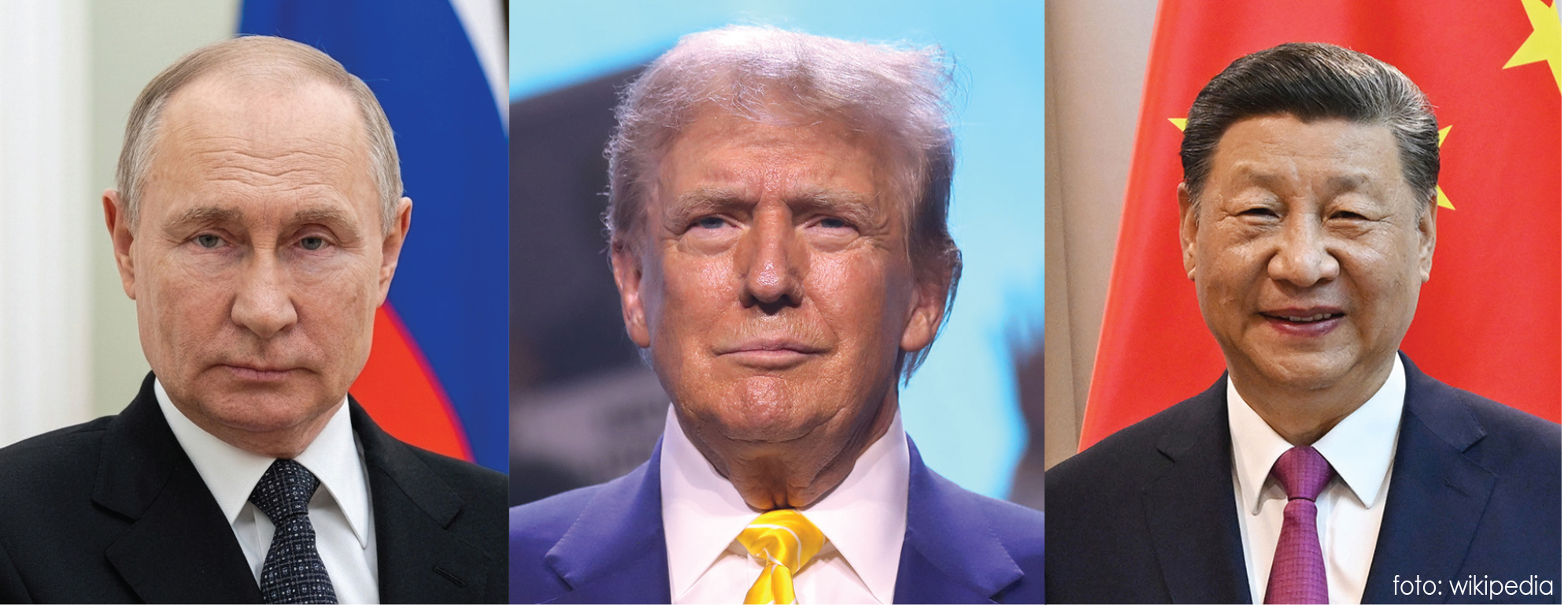
On November 11, The South China Morning Post, a Hong Kong’s newspaper, which is often used by Chinese government to express its position, reported that situation in Ukraine would not be discussed at the trilateral meeting of the leaders of the US, Russia and China. The meeting is scheduled to take place on the sidelines of APEC Economic summit, which will be held in Chinese Shenzhen on November 18-19.
Russian president Vladimir Putin was certainly informed about the unwillingness of the Chinese leader Xi Jinping to include the peace settlement in Ukraine into the agenda of the meeting long before it was stated publicly. Due to that, the negotiations in Abu Dhabi, that took place on November 10-11, had been doomed, before it was even started. The main obstacle to peace has been remaining the same for the last two years. The Kremlin wants the territory of whole Donbas region. It is less than Russia demanded in the beginning of the war. There is no practical possibility of conquering the Southern and Eastern Ukraine, not to mention capturing of Kyiv, which was supposed to happen according to initial Putin plans. However, Ukraine’s president still cannot comply with Russian demands without ruining his political career. Therefore, the truce can be established, either if Kyiv is compelled by Washington to make concessions, or if Putin is offered something so attractive and significant that he will suppress his desire to look like an obvious winner.
There is only one thing that Putin wants more than to demonstrate Russians that he managed to recollect “historical Russian lands” and to show Europeans that he can effectively use military force to achieve his goals. He wants to be regarded as a ruler, who has returned the status of global power to Russia. Soon after the annexation of the Crimea the idea of negotiations between Russia, the US and China, similar to a new Yalta conference, at which Stalin, Roosevelt and Churchill agreed on division of the post-war spheres of influence in February 1945. It was clear, that Biden’s administration would never agree on such negotiations. So the execution of the “New Yalta” project was postponed. But the Kremlin has never forgotten about it.
The trilateral meeting, scheduled in Shenzhen was not exactly what Putin and his associates imagined, but it would certainly help create in impression that Russia is recognized as one of the global powers. Therefore, it will provide an opportunity for Moscow to agree on serious concessions in order to end the war in Ukraine. In that case, leaving a part of Donbas outside Russia would look, as a sacrifice made in the name of consensus between the three global leaders.
If the situation in Ukraine is not discussed, Putin will lose the opportunity to make territorial compromises, not admitting his failure. In that case, he has no need to reduce his demands on territorial gains. It seems, that Abu Dhabi negotiations were regarded by the Kremlin as a prelude to the meeting of the world’s three largest nuclear powers. That’s why Moscow insists on discussion of the architecture of security of the whole Eurasia (and not just of Europe). It is supposed to find a pretext for engaging China in working out conditions of the peace settlement in Ukraine. The Kremlin even organized International collective security Forum with the participation with the participation of the representatives of member states of the Shanghai cooperation organization. The Forum was held on November 10, the same day the Abu Dhabi talks started.
However, after Beijing had refused to debate on the conditions of peace in Ukraine, the discussion of Eurasian peace architecture lost any practical meaning for the Kremlin. Head of Russian delegation in Abu Dhabi Vladimir Medinsky, an advisor to the Russian president, turned the talks on security issues into a farce. He demanded withdraw of military infrastructure and NATO formations from all the countries that joined the alliance after 1997. It is hard to imagine a person, who believes that it can be really carried out, especially in the current circumstances. Medinsky was pretending to insist on that just to stress that Russia does not seek any compromises. He also made an appeal to cede Russia all the Ukrainian territories occupied Russian troops, even outside the regions that Russia regards as a new part of its territory. He said that the land on which Russian soldier stepped on, should belong to Russia. It is a refusal even to think about peace before Ukraine’s capitulation.
Of course, it does not mean that Medinsky’s declarations should be regarded as an expression of the Kremlin’s final position that cannot be changed. It is just an attempt to suspend the discussion, until Putin decides that he can gain more from ending the war than from going on with it. He expected China to provide him with a good pretext for concessions. It is not going to happen. The EU leaders do not want Russian to look like a winner, and the EU delegation in Abu Dhabi demonstrated it once again. So the US remains the only country that can offer to Russia something it badly needs and make Russia terminate the hostilities. It should be taken into consideration that financial difficulties that Russia is facing because of the war are increasing, despite the high prices on oil. So Putin’s demands will be inevitably reduced. Nevertheless, he can refuse from capturing the territory of the whole Donbas only in exchange of something extraordinary attractive. And the US president Donald Trump is concentrated on reaching his own goals, and needs Russia significantly less than Vladimir Putin appears to think.
In contrast with the EU, Trump has nothing against granting to Russia all its territorial gains and withdrawing Ukrainian troops from the part of Donbas that still remains under Ukraine’s control. But will not help Russia to achieve that until he knows what relations between Russia and Europe he needs.
Trump’s plans were also disrupted by Xi Jinping’s intentions to bring the agenda of discussion in alignment with China’s requirements. It is extremely important for Trump to make China stop increasing its nuclear arsenal, which threatens first of all to Japan and South Korea, two main American allies in the Eastern Asia and ensure Chine’s military dominance in the region. Beijing, in its turn, is interested in strengthening national nuclear capability.
Trump and US Secretary of State Marco Rubio stated that China must be included in a new agreement that limits nuclear arsenals, and that this issue should be addressed in Shenzhen. Beijing, however, has categorically rejected any trilateral discussion on the matter. China does not want to be constrained by a treaty. Chinese nuclear arsenal remains significantly smaller than Russian and American ones. If China is not allowed to enlarge it, Beijing will not be able to offer its allies the same military protection as the US. And it can hinder Chinese global expansion, which in the current circumstances can become essential for retaining an achieved level of economic prosperity.
It has been reported that China suggested to focus the discussion on establishing restrictions on integration of artificial intelligence (AI) into nuclear arsenals. However, the outcome of such debates might be harmful for the American plans. Leading the world in AI appears in the beginning of the official list of the White House priorities. And the Trump’s administration hardly needs any restrictions, which can obstruct gaining all possible advantages from such global leadership. Besides, an agreement on the military use of AI, even if it is reached, will not help to prevent China from increasing its nuclear arsenal.
The expectations of the US, Russia and China from their trilateral meeting significantly differs. They has not been able so far even to overcome contradictions on the the format and agenda of the negotiations. Beijing insists that the meeting follow a script fully determined in advance, in order to avoid any unexpected development of discussion. The Trump administration, in its turn, is insisting on a free exchange of views, unconstrained by rigid protocol. Xi Jinping because of domestic political situation has to avoid anything unpredictable, because he needs nothing from the upcoming summit but the propaganda effect, that can have an impact on the public mind.
The recent plenum of the Central Committee of the Chinese Communist Party (CCP), which ended on October 29, adopted the resolution, which urges the CCP to strengthen internal discipline, and fight against nepotism. It means that anti-corruption campaign started by Xi Jinping in 2012 will be continued. The data on the results of this campaign is unavailable, but it is known that almost 2,4 million of state and party bureaucrats (including police and military) were prosecuted or disciplined by 2023. And since then the campaign has been increased. There was a historically low attendance rate at the plenum, just 74%, 97 members failed to attend. It was supposed that they were absent, because they under investigation. The plenum confirmed 33 expulsions from the Central Comitte (which is a record). Due to the ongoing attempts of Xi Jinping to subdue opposition of the army to his military strategy, 16 out of the expelled officials were military commanders, and the representation of the army has sharply diminished. In such circumstances, Xi Jinping cannot appear neither too soft, no too aggressive in regard to national security issues and avoid any negotiations , which cam lead to fatal decisions. Therefore, Xi Jinping cannot even discuss any significant concessions, which can impact national security or economic development.
So Trump will have to have to increase pressure on China to make Beijing start negotiations. And to achieve that he needs to have Russia on his side. Russia should become politically dependable on the Trump administration. Due to that confrontation between the EU and Russia should be intensified, but the US should remain in good relations with both of them. So it can be expected that Trump’s attitude to the EU will be improved. The EU delegation was invited to the negotiations in Abu Dnabi, though initially they were supposed to be held in the trilateral format (between Russia, the US and Ukraine). There is no doubt, that Trump wants to end hostilities in Ukraine as soon as possible, because he is willing to start joint projects with Russia connected with oil and gas export. But as the negotiations in Abu Dhabi has shown, Washing is going to refrain from compelling Kyiv to make territorial concessions to Russia. Moscow has to be in strong need of the US support, and should be brought on the edge of the military conflict with the EU. Only in that case, it can be made to join the US demands of an agreement on restriction of nuclear arsenals. Further escalation of the conflict between the Russia and the EU can be extremely dangerous for both sides, but Trump hardly has any concerns about it. At least, until there is a chance that he might get what he needs by manipulating Putin.
Komentari
IN ENGLISH
Uncertain Fate of Wars in Ukraine and Iran: Trump Does Not Need Peaceful Solutions Before a Deal with China
Objavljeno prije
3 sedmicena
1 Novembra, 2026
At present, Trump is interest to keep the conflict in Ukraine in its current state. According to his vision, Ukraine should not be defeated, but it should find itself in a difficult situation from which it cannot extricate itself on its own. Furthermore, Trump has no need for a peace agreement with Iran at this time. In a speech before the UN General Assembly, he told Iranian leaders to understand that he is “not running for office” and that the potential outcome of the U.S. Elections cannot influence his approach to the war
On October 20, it was reported that Elon Musk ordered a slowdown of Starshield (a military-grade satellite network built by SpaceX) services in Ukraine. Musk himself had earlier denied giving any direct orders. However, it is easy to comprehend the reasons both for his decision to slowdown Starshield, and for attempts to evade responsibility for it. Like many people, who got involved in politics, but have no political talents, he understands others too literally and too easily gets confused, when his mistakes are found out. The US president Donald Trump did not want Ukraine to lose ability to conduct air-attacks in the depths of Russian territory. He just wanted to show that he was annoyed with Ukraine and justify his intentions to start economic cooperation with Russia before establishing truce. Trump does not need Russian problems to be solved before the agreement with the Kremlin is reached. In accordance with his intentions, Ukraine should not be defeated, but it should be in a difficult situation and unable to find a way out of it by itself. Musk can be advised to take an example from Pete Hegseth, the US secretary of war, who did not forbid to supply Ukraine with missiles for “Patriot” air defense systems. He is not just giving permission to do it.
At present, Trump does not need peaceful solutions both in Iran and Ukraine, because after his failure in the war with Iran, he wants to work out a new strategy first. And it, in its turn, will depend on his agreement with China. Until it is reached, he is interested to keep both conflicts in their current state. Any efforts to make him take a decision will prove to be fruitless.
On October 16, Russian president Vladimir Putin chaired a meeting with senior members of the General staff of the Russian armed forces. It should be noted that after the famous American public relations firm Ketchum terminated its contract for managing the Kremlin’s image in 2015, the organization of the events with Putin’s participation has been gradually deteriorating. The meeting purposed to persuade everyone that Russia is very close to victory, was held under the camouflage net, but inside the building. Such design was surely supposed to create impression that the leaders of the successful army are commanding its offensive operations close to the battlefield. It just looked comically. However, even if the meeting had more persuasive appearance, it would not influence Trump’s position. He is not trying to help the Kremlin to end the war on its terms. He just showed that he would be willing to do it, if he found it useful. There were forecasts that special envoys of the US president Steve Witkoff and Jared Kushner would demand capitulation from Ukrainian president Volodymir Zelenskyy at the negotiations in Oslo, on October 20. Those dark predictions proved to be wrong. Witkoff and Kushner came to discuss the potential peace frameworks and confirm that the US resume sharing early-warning data on Russian missile attacks.
Trump’s approach to the resolution of the war with Iran is the same. He has nothing against it, he just does not need it now. The American president at his speech at the UN General assembly warned Iranian leaders that they were making a mistake thinking that he would need a peace treaty to improve the results of the Republican party on the Congress midterm elections. He advised them to realize that “he is not running” and the possible outcome of elections cannot influence his approach to the war. The US president might exaggerate his indifference to the election results. However, the analyses of the US political situation can prove that he is basically sincere. The upcoming elections cannot prevent him from taking a decisive part in nomination of the Republican candidate in the presidential elections. Even if the Republican party lose majority in congress both chambers, it will not be able to refuse from Trump’s leadership, because he remains much more popular than any other Republican politician. And success of the Democratic party in the Congress elections does not mean that it will be able to find a presidential candidate, who can seriously count on victory.
Nevertheless, the Iranian government tried once again to persuade Trump to come to an agreement. On October 18, Foreign Minister Abbas Araghchi made an offer to open the Strait of Hormuz on the sidelines of an Organization of Islamic Cooperation (OIC) meeting in Baghdad. Araghchi stated, that the strait could be opened within seven days. He reiterated that the conditions for this include an end to the U.S. blockade of Iranian ports and the lifting of sanctions on oil exports. Iranian proposal looks attractive now, when the Brent crude oil is trading at almost 110 USD per barrel. But there are no signs that the US president cares about oil prices so much that he would sacrifice freedom of action in exchange for their decrease.
Of course, high oil prices worsen economic situation worldwide, including the US, but American oil corporations make huge profits because of them. And even after the comparatively safe “southern route” through the Strait of Hormuz was established under US naval protection in the middle of the summer, Trump from time to time threatened to resume air-strikes on Iran preventing oil-prices from falling. The US president never carried out his promises. He also blocked the plans of Israeli prime minister Benjamim Netanjahu to launch large-scale airstrikes earlier strikes against Iran earlier in October. Trump does not neither a peace agreement with Iran, nor a resumption of the war, before he can work out a new approach to global affairs.
That’s why the US will not respond to the new strikes on commercial vessels committed by the the Iranian Revolutionary Guards Corps (IRGC). On October 17, IRGC declared the Strait of Hormuz closed to all passages and called the “southern route” illegal.
Such an action put more weight on Araghchi’s speech at the OIC meeting, and showed that Iran wants peace, though Iranian forces can still control one of the most important global trade routes. On October 19, the IRGC reported that three oil tankers were set ablaze due to the explosion of mines planted by the IRGC Navy. It means that Iran has no reason to capitulate, and the US will have to make concessions to achieve an agreement. However, the US administration can not carry out meaningful negotiations right now. First, it should evaluate the level of compromise. And it depends on the outcome of the negotiations with China.
It became obvious, that the US will not be able to obtain full control over the Strait of Hormuz and the Iranian oil export. So the US administration can reach only one of the primary goals of the war against Iran, a significant reduction in Iran’s uranium enrichment. Of course, it is extremely important for Israeli national security and military domination in the region. But it has also strategic significance for the Trump’s administration. After Iran cease to impose a potential threat to the key American allies in the Middle East and lose a chance to compete Israel on the same footing, the US administration will be able to reduce its military presence in the region. It costs a lot, and without control over the main sea trade routes has little value for Donald Trump, who believes that the US does not need geopolitical engagements, which do not bring advantages in international trade. But the conditions of peace of Iran has to be extremely severe, if Washington cannot persuade Beijing to
stop increasing its nuclear arsenal. In that case, the US will have to maintain its military presence in the main global regions anyway. Putting strong pressure on Iran until its capitulation will give both a goal and a justification for the military activity in the Middle East. If China agrees on the US terms, the peace between the US and Iran can be concluded on the terms that will just guarantee the absence of the nuclear weapons at Iran’s disposal in the foreseeable future.
Donald Trump has already tried to make president of China Xi Jinping start negotiations on restrictions of nuclear arsenal. He even refused to prolong New START treaty with Russia which expired on February 5, under pretext that it is necessary to include China in the new agreement. New Start treaty signed by Washington and Moscow in 2010 limited each country to no more than 1550 deployed strategic nuclear warheads. At present, China has no more than 600 warheads altogether. So Xi Jinping refused to discuss any restrictions on increasing nuclear arsenals, explaining that Chinese nuclear capabilities cannot be even compared with Russian and American. But because China continues to increase the number of warheads, the US are facing a difficult problem. Washington will have to spend money on modernizing American missiles instead of concentrating on development and production of conventional weapons.
Nuclear warheads were extremely important during the “cold war”, when two rival blocs competed for global domination. The Trump’s administration wants the US to become the sole leading power of the world (it seems to be unachievable, but it is another question). A huge nuclear arsenal is irrelevant for this purpose, but without the most advanced conventional weapons it cannot be reached. The US will gladly agree to diminish the number of deployed warheads, if it will help to avoid expenses on the development and production of new missiles. It seems that Beijing does not want to give Washington such an opportunity.
However, thanks to Vladimir Putin, Donald Trump will have an opportunity to make one more attempt to persuade Xi Jinping, offering him something in return, including peace with Iran on the terms which will make it possible to resume export of the Iranian oil to China. The Russian President managed to organize trilateral talks between Russia, China and the US on the sidelines of the Asia-Pacific Economic Cooperation (APEC) summit, scheduled for November 18–19 in Shenzhen.
It has become known that Putin and Trump discussed the possibility of the trilateral meeting during their phone call on October 9. But it was confirmed only on October 19 that the meeting will actually tale place, after Beijing decided to take part in negotiations. Trump stated that the discussions would focus primarily on nuclear weapons. Vladimir Putin wants first of all to work out the common plan of ending the war in Ukraine in hopes of making Donald Trump and Xi Jinping agree on his conditions. Trump stated that he would do “everything he can to end the war.” It means that Trump can significantly increase pressure on Ukraine, if he comes to understanding with China and finds no need to increase confrontation with Beijing. The peace in Ukraine on Russian conditions will inevitably lead to a long-lasting conflict between Russia and the EU. It will make Russia politically dependent on China. The EU, in its turn, will be compelled to concentrate on opposing Russian and on fighting internal divisions. And it will be the exact peaceful solution Donald Trump needs.
Dmitry GALKIN
Komentari

INSTITUTIONAL CRISIS IN POLAND: “Judgment Tuesday” and its unpredictable consequences
EU PUT I NEKAŽNJENI RATNI ZLOČINI: Saglasni u zaboravu
STANOVI ZA PRIVILEGOVANE IZMEĐU PARLAMENTA I USTAVNOG SUDA: Što se grbo rodi…
Izdvajamo
-
IN ENGLISH3 sedmiceBACKGROUND OF MIHAILO ZINČUK’S MISSION IN MONTENEGRO: Helped to be discovered
-
IN ENGLISH3 sedmiceUncertain Fate of Wars in Ukraine and Iran: Trump Does Not Need Peaceful Solutions Before a Deal with China
-
IN ENGLISH3 danaINSTITUTIONAL CRISIS IN POLAND: “Judgment Tuesday” and its unpredictable consequences
-
IN ENGLISH3 sedmiceDROUGHT AND TWO WARS CREATE GRAIN SHORTAGE: On the brink of global famine
-
DRUŠTVO4 sedmiceŠKOLE NA SJEVERU: Za deceniju 4000 manje osnovaca
-
DRUŠTVO4 sedmiceBUDVA IZMEĐU DVA MEĐUNARODNA KONKURSA: Za ideje utrošeno 300.000 a promenada i dalje čeka
-
DRUŠTVO4 sedmiceDRI DALA DVOSTRUKO NEGATIVNO MIŠLJENJE MINISTARSTVU ZDRAVLJA: Milioni bez potpunog revizorskog traga
-
Izdvojeno4 sedmiceNEIZVJESNA SUDBINA RATOVA U UKRAJINI I IRANU: Trampu nisu potrebna mirna rješenja prije sporazuma s Kinom