IN ENGLISH
HOW HIGH SCHOOL STUDENTS ACCEPTED STAY-AT-HOME AND SOCIAL DISTANCING ORDERS: Time of Worrying and Learning
Objavljeno prije
6 godinana
Objavio:
Monitor online
It has been shown that keeping prescribed distance without physical contact, shaking hands, hugging … is one of the least respected measures among surveyed high school students. According to received answers, the only recommendation that was less respected was the one concerning wearing of protective equipment
Do high school students in Podgorica and to what extent respect the measures taken to prevent coronavirus spread? Through social networks, we surveyed about 200 students, from all high schools in Podgorica, to find out first-hand, how they cope with recommendations and measures that, among other things, limit movement and outdoor activities.
“Ever since the coronavirus appeared in Montenegro and since the Government announced the protective measures, I fully comply with them,” Elena Dabetic told us. “I haven’t been out of the house since March, even when I have to go to the store, I go with full equipment: masks, gloves, and I keep distance from other people. Quarantine was not difficult for me since I’ve focused on some other activities, for which I did not have time, such as drawing. I kill boredom by playing online video games with my friends, watching movies, reading books, etc. I believe that people just need to think positively and use this time to work on themselves; well, we have a lot of time and we will learn more to appreciate going out after all this.”
Others, again, relativized the danger and explained why they did not exactly adhere to the imposed measures of social distancing. In fact, it was shown that keeping a prescribed distance of 1-2 meters without physical contact, shaking hands, hugging…was one of the least respected measures among surveyed high school students. Only every tenth respondent respected this experts’ recommendation. Even less number of respondents, according to received answers, respected recommendation concerning wearing of protective equipment. It was respected by every fifth research participant.
“When it comes to quarantine, I was relaxed at first, but when the situation intensified, I took it more seriously,” said Isidora Milatovic. “It is difficult for me to get used to it. This is the first time I am faced with situation like this. I spend my time learning, so I don’t really do any other activities. I sincerely hope that the situation will stabilize and that we will soon return to a normal life. ”
Her peer Danilo Kujacic explained: “I accept quarantine well, since my usual lifestyle is not much different. I spend most of my day at the computer. I go out with friends in the evening or occasionally, go out for training. I think the current situation is exaggerated and not half as significant as the media present it.”
A significant number of young people, according to their own testimonies, comply with the recommendations and stay at home. Survey has found that watching series and movies, playing games on a phone/computer and using social networks are three of the most common activities young people currently do. According to collected data, every tenth respondent takes an online course, learns a foreign language and (or) reads extracurricular literature.
Milica Radulovic stated that the current situation disturbed everyone’s usual activities, but, as she said, we must accept this way of life. “We all eagerly wait for measures to ease, but until that happens, we must use this time as good as possible. I suggest that we all devote this time to ourselves: by doing home-based training, reading a book, studying, but also communicating with friends through social networks. If after doing all of these you still have spare time, you can always watch a series or a movie…”, said our interviewee. And she concluded: “I really miss gatherings in the neighbourhood, but these measures must be respected if we want to get back to our old habits as soon as possible.”
In our survey, high school students cited several common reasons why they went out: a third of surveyed participants went out to shop at stores and pharmacies; a quarter for a walk or training in nature; every fifth for meeting and hanging out with friends… Boris Janjusevic said: “It was strange at first, but over time I got used to it. I spend my time doing homework, but of course I play games more than usual. As usual I spare an hour, an hour and a half of time for training.”
Given the new circumstances, interaction between students and professors in the school classroom has been replaced by online teaching, a platform and a website. Survey showed that most students did assignments, presentations, essays which professors gave, as well as that they studied provided resources. However, based on the results, two-thirds of high school students were not satisfied with online teaching, since, as they said, new way of work, to which they were not used to, required more work, effort and time than “traditional” class attendance.
Almost everyone missed social life, going out and socializing (without set limits). “I am very bored in quarantine and it has been difficult for me to find anything interesting to do”, notes S.P. who wanted to remain anonymous. “I usually play games, write songs, listen to music or do my homework. The current situation has great impact on us and our psyche. When all this is over, the consequences will be visible in our country, as well as in the whole world”, he said.
On the other hand, a smaller number of respondents said that they did not have any difficulties during quarantine. They believe that there has not been any other situation in which they would have so much time to devote to themselves and to improve their skills and potentials. Thus, M.P. explained: “I learn languages during quarantine. I try to organize myself well, especially because of my school obligations. Of course, this is not always possible, but I manage. I also watch movies, communicate with friends, and read books. This is a chance to correct most of the mistakes, because time, despite the space barrier, works in our favour. ”
We spoke with Patricia Pobric, a civic activist and Executive Director of the NGO Our Action, about the behaviour of young people in this new situation caused by coronavirus pandemic and in what way they can make useful contribution.
“One who understands young people understands that current situation is most difficult to them. It’s still easy for kids to have fun at home with toys and other activities, but young people are, by their nature, very social beings. They like to move, to socialize, go out…Although we consider that they are too much attached to their phones, physical socializing means a lot to them. In general, I think most young people understood the significance of the situation, and that it was accepted with understanding but not with fear. Only young people to whom parents, relatives, and media transferred fear, showed it.”
Pobric however, pointed out that there were also undesirable examples. “It happens that a small number of young men drives their vehicles after curfew, or organize trips and barbecues and do not respect social distancing. My advice to young members of NGO Our Action, from the beginning of quarantine, was to spend time after online school activities not only on games and internet, but also on planting, working on farms, gardens, learning new skills at home and in nature.” Photos prove that some have accepted the advice.
Zana KNEZEVIC
Komentari
IZDVOJENO
-
POCKET MONEY PROVIDED BY THE WEB: Item, Account, Euro
-
CONDITIONS FOR CONDUCTING PHYSICAL EDUCATION: Coronavirus Returned Youth to Sports
-
SILENT KILLER: DRUG ADDICTION AMONG YOUNG PEOPLE IN MONTENEGRO: Growing Hopelessness
-
DO DŽEPARCA NA VEBU: Item, akaunt, euro
-
KAKO SU SREDNJOŠKOLCI PRIHVATILI OSTANAK KUĆI I SOCIJALNU DISTANCU: Vrijeme muke i nauke
-
TIHI UBICA – NARKOMANIJA MEĐU MLADIMA U CRNOJ GORI: Beznađe koje raste
IN ENGLISH
Uncertain Fate of Wars in Ukraine and Iran: Trump Does Not Need Peaceful Solutions Before a Deal with China
Objavljeno prije
8 satina
1 Novembra, 2026
At present, Trump is interest to keep the conflict in Ukraine in its current state. According to his vision, Ukraine should not be defeated, but it should find itself in a difficult situation from which it cannot extricate itself on its own. Furthermore, Trump has no need for a peace agreement with Iran at this time. In a speech before the UN General Assembly, he told Iranian leaders to understand that he is “not running for office” and that the potential outcome of the U.S. Elections cannot influence his approach to the war
On October 20, it was reported that Elon Musk ordered a slowdown of Starshield (a military-grade satellite network built by SpaceX) services in Ukraine. Musk himself had earlier denied giving any direct orders. However, it is easy to comprehend the reasons both for his decision to slowdown Starshield, and for attempts to evade responsibility for it. Like many people, who got involved in politics, but have no political talents, he understands others too literally and too easily gets confused, when his mistakes are found out. The US president Donald Trump did not want Ukraine to lose ability to conduct air-attacks in the depths of Russian territory. He just wanted to show that he was annoyed with Ukraine and justify his intentions to start economic cooperation with Russia before establishing truce. Trump does not need Russian problems to be solved before the agreement with the Kremlin is reached. In accordance with his intentions, Ukraine should not be defeated, but it should be in a difficult situation and unable to find a way out of it by itself. Musk can be advised to take an example from Pete Hegseth, the US secretary of war, who did not forbid to supply Ukraine with missiles for “Patriot” air defense systems. He is not just giving permission to do it.
At present, Trump does not need peaceful solutions both in Iran and Ukraine, because after his failure in the war with Iran, he wants to work out a new strategy first. And it, in its turn, will depend on his agreement with China. Until it is reached, he is interested to keep both conflicts in their current state. Any efforts to make him take a decision will prove to be fruitless.
On October 16, Russian president Vladimir Putin chaired a meeting with senior members of the General staff of the Russian armed forces. It should be noted that after the famous American public relations firm Ketchum terminated its contract for managing the Kremlin’s image in 2015, the organization of the events with Putin’s participation has been gradually deteriorating. The meeting purposed to persuade everyone that Russia is very close to victory, was held under the camouflage net, but inside the building. Such design was surely supposed to create impression that the leaders of the successful army are commanding its offensive operations close to the battlefield. It just looked comically. However, even if the meeting had more persuasive appearance, it would not influence Trump’s position. He is not trying to help the Kremlin to end the war on its terms. He just showed that he would be willing to do it, if he found it useful. There were forecasts that special envoys of the US president Steve Witkoff and Jared Kushner would demand capitulation from Ukrainian president Volodymir Zelenskyy at the negotiations in Oslo, on October 20. Those dark predictions proved to be wrong. Witkoff and Kushner came to discuss the potential peace frameworks and confirm that the US resume sharing early-warning data on Russian missile attacks.
Trump’s approach to the resolution of the war with Iran is the same. He has nothing against it, he just does not need it now. The American president at his speech at the UN General assembly warned Iranian leaders that they were making a mistake thinking that he would need a peace treaty to improve the results of the Republican party on the Congress midterm elections. He advised them to realize that “he is not running” and the possible outcome of elections cannot influence his approach to the war. The US president might exaggerate his indifference to the election results. However, the analyses of the US political situation can prove that he is basically sincere. The upcoming elections cannot prevent him from taking a decisive part in nomination of the Republican candidate in the presidential elections. Even if the Republican party lose majority in congress both chambers, it will not be able to refuse from Trump’s leadership, because he remains much more popular than any other Republican politician. And success of the Democratic party in the Congress elections does not mean that it will be able to find a presidential candidate, who can seriously count on victory.
Nevertheless, the Iranian government tried once again to persuade Trump to come to an agreement. On October 18, Foreign Minister Abbas Araghchi made an offer to open the Strait of Hormuz on the sidelines of an Organization of Islamic Cooperation (OIC) meeting in Baghdad. Araghchi stated, that the strait could be opened within seven days. He reiterated that the conditions for this include an end to the U.S. blockade of Iranian ports and the lifting of sanctions on oil exports. Iranian proposal looks attractive now, when the Brent crude oil is trading at almost 110 USD per barrel. But there are no signs that the US president cares about oil prices so much that he would sacrifice freedom of action in exchange for their decrease.
Of course, high oil prices worsen economic situation worldwide, including the US, but American oil corporations make huge profits because of them. And even after the comparatively safe “southern route” through the Strait of Hormuz was established under US naval protection in the middle of the summer, Trump from time to time threatened to resume air-strikes on Iran preventing oil-prices from falling. The US president never carried out his promises. He also blocked the plans of Israeli prime minister Benjamim Netanjahu to launch large-scale airstrikes earlier strikes against Iran earlier in October. Trump does not neither a peace agreement with Iran, nor a resumption of the war, before he can work out a new approach to global affairs.
That’s why the US will not respond to the new strikes on commercial vessels committed by the the Iranian Revolutionary Guards Corps (IRGC). On October 17, IRGC declared the Strait of Hormuz closed to all passages and called the “southern route” illegal.
Such an action put more weight on Araghchi’s speech at the OIC meeting, and showed that Iran wants peace, though Iranian forces can still control one of the most important global trade routes. On October 19, the IRGC reported that three oil tankers were set ablaze due to the explosion of mines planted by the IRGC Navy. It means that Iran has no reason to capitulate, and the US will have to make concessions to achieve an agreement. However, the US administration can not carry out meaningful negotiations right now. First, it should evaluate the level of compromise. And it depends on the outcome of the negotiations with China.
It became obvious, that the US will not be able to obtain full control over the Strait of Hormuz and the Iranian oil export. So the US administration can reach only one of the primary goals of the war against Iran, a significant reduction in Iran’s uranium enrichment. Of course, it is extremely important for Israeli national security and military domination in the region. But it has also strategic significance for the Trump’s administration. After Iran cease to impose a potential threat to the key American allies in the Middle East and lose a chance to compete Israel on the same footing, the US administration will be able to reduce its military presence in the region. It costs a lot, and without control over the main sea trade routes has little value for Donald Trump, who believes that the US does not need geopolitical engagements, which do not bring advantages in international trade. But the conditions of peace of Iran has to be extremely severe, if Washington cannot persuade Beijing to
stop increasing its nuclear arsenal. In that case, the US will have to maintain its military presence in the main global regions anyway. Putting strong pressure on Iran until its capitulation will give both a goal and a justification for the military activity in the Middle East. If China agrees on the US terms, the peace between the US and Iran can be concluded on the terms that will just guarantee the absence of the nuclear weapons at Iran’s disposal in the foreseeable future.
Donald Trump has already tried to make president of China Xi Jinping start negotiations on restrictions of nuclear arsenal. He even refused to prolong New START treaty with Russia which expired on February 5, under pretext that it is necessary to include China in the new agreement. New Start treaty signed by Washington and Moscow in 2010 limited each country to no more than 1550 deployed strategic nuclear warheads. At present, China has no more than 600 warheads altogether. So Xi Jinping refused to discuss any restrictions on increasing nuclear arsenals, explaining that Chinese nuclear capabilities cannot be even compared with Russian and American. But because China continues to increase the number of warheads, the US are facing a difficult problem. Washington will have to spend money on modernizing American missiles instead of concentrating on development and production of conventional weapons.
Nuclear warheads were extremely important during the “cold war”, when two rival blocs competed for global domination. The Trump’s administration wants the US to become the sole leading power of the world (it seems to be unachievable, but it is another question). A huge nuclear arsenal is irrelevant for this purpose, but without the most advanced conventional weapons it cannot be reached. The US will gladly agree to diminish the number of deployed warheads, if it will help to avoid expenses on the development and production of new missiles. It seems that Beijing does not want to give Washington such an opportunity.
However, thanks to Vladimir Putin, Donald Trump will have an opportunity to make one more attempt to persuade Xi Jinping, offering him something in return, including peace with Iran on the terms which will make it possible to resume export of the Iranian oil to China. The Russian President managed to organize trilateral talks between Russia, China and the US on the sidelines of the Asia-Pacific Economic Cooperation (APEC) summit, scheduled for November 18–19 in Shenzhen.
It has become known that Putin and Trump discussed the possibility of the trilateral meeting during their phone call on October 9. But it was confirmed only on October 19 that the meeting will actually tale place, after Beijing decided to take part in negotiations. Trump stated that the discussions would focus primarily on nuclear weapons. Vladimir Putin wants first of all to work out the common plan of ending the war in Ukraine in hopes of making Donald Trump and Xi Jinping agree on his conditions. Trump stated that he would do “everything he can to end the war.” It means that Trump can significantly increase pressure on Ukraine, if he comes to understanding with China and finds no need to increase confrontation with Beijing. The peace in Ukraine on Russian conditions will inevitably lead to a long-lasting conflict between Russia and the EU. It will make Russia politically dependent on China. The EU, in its turn, will be compelled to concentrate on opposing Russian and on fighting internal divisions. And it will be the exact peaceful solution Donald Trump needs.
Dmitry GALKIN
Komentari
IN ENGLISH
BACKGROUND OF MIHAILO ZINČUK’S MISSION IN MONTENEGRO: Helped to be discovered
Objavljeno prije
8 satina
1 Novembra, 2026
After entering Montenegro, Zinchuk described the Montenegrin border police on his telegram-channel as incompetent for failing to stop him, even though he is subject to EU sanctions. He must have known that his media activities would come under the scrutiny of the Montenegrin authorities. Evidently, he wanted to provoke his own public failure. This is not Zinchuk’s only setback; in late September, employees of his channel were deported from the Czech Republic. It can be assumed that he intended to demonstrate that his network in Europe is being monitored and cannot be used for covert operations
On October 9, Russian propagandist Michael Zinchuk, his wife and three employees were deported from Montenegro, where they had arrived just two days before. Zinchuk operates several media projects, including his main telegram-channel “Rybar” with almost 1,4 million subscribers (telegram-channels are not widely used in Montenegro, but extremely popular in Russia). Zinchuk, despite his Ukrainian last name, is one of the most influential professional warmongers, who calls for fighting the war until the destruction of the independent Ukrainian state. Moreover, he is considered to be in charge of spreading messages that reflect the real opinion of hawks in the inner circle of Russian president Vladimir Putin.
There is one question, which remains unanswered: why did Zinchuk decide to come to Montenegro. He explained that he had intended to make a documentary about economic and social difficulties that in his opinion, Montenegro would face after joining the EU. But that explanation contradicts his behavior. Soon after entering Montenegro, he published a post in his channel, in which he insulted the Border Police of Montenegro, which he called incompetent for not stopping him, though he is under the EU sanctions. Such a declaration appears to be extremely stupid, because Zinchuk must have known that his media activity would be observed by the Montenegrin law-enforcement agencies. Instead of trying to disguise himself as tourist as long as possible, he started with mocking the government agency, on which depends his stay in the country.
The only possible answer is that he came to be arrested and deported. He knew that would be defended on the highest level. Spokesperson of Russian ministry of foreign affairs Maria Zakharova personally coordinated the activity of Russian embassies in Serbia and Montenegro in support of Zinchuk. The Russian broadcaster RT and media group Rossiya Segodnya, which target the audience outside Russia, highlighted news about Zinchuk’s arrest, because their editor-in-chief Margarita Simonyan issue a direct instruction to someone to do it. So Zinchuk did not have much to have much to fear. And he obviously wanted to fail publicly.
By the way, it was at least Zinchuk’s failure in the recent weeks. In the end of September the employees of Zinchuk’s channel were deported from the Czech Republic, after they had too frankly talked with local journalist, who happened to investigate their activity in Europe. What seemed just a silly mistake can be regarded in another light now.
It is possible to make a suggestion. Zinchuk wanted to show that his net in Europe is being closely watched and cannot be used for undercover operations. He and his employees are easily identified and exposed. It has been reported that after the election defeat of former Hungarian president Victor Orban, there has been a radical shift in the approach to the goals and means of the undercover activity in Europe. Supporting pro-Russian political forced has been recognized to be ineffective. It has been decided that more serious effects on public opinion can be achieved through social destabilization by actions of political radicals and acts of sabotage. Zinchuk might want to avoid participation of the members of his disinformation net in Europe in the execution of such plans. And the prospect of the implementation has become stronger in the last weeks. Because Russian president Vladimir Putin seems to believe that he has come close to making a deal with the US, which will give him a free hand in undermining the EU. In one of his recent speeches he revealed that he expects the EU to fall apart in the near future, but assured that he is not going to do anything to make it happen faster. Based on experience of Putin’s long rule, it can be taken for granted, that if he publicly assures of his inaction, he has already decided to increase his activity.
Vladimir Putin is making the same mistake in his perception of the US president Donald Trump, as he made regarding his predecessors Barack Obama and Joe Biden. He thought that Obama’s feeble reaction on the annexation of the Crimea and instigation of the military conflict on Donbas proved that the US had no intentions and resources to impede Russia. It turned out that Obama’s administration just wanted the Kremlin to get stuck in the conflict in Ukraine to disrupt the economic cooperation between Russia and Germany (and the EU as a whole). Putin believed that Biden’s administration would not impose serious sanctions on Russia and provide meaningful military assistance to Ukraine. And he was wrong again.
Biden’s sanctions were aimed at the restraining Russian economic development, not at the inflicting immediate damage on Russian economy. Due to that, Vladimir Putin was confident for some time that American sanctions were not working, and Russian propaganda was eager to demonstrate it. Now, the Kremlin wants to American sanctions to be lifted. And Putin expects Trump to do that, because he regards Trump as a potential ally in the confrontation with the EU.
Of course, there is no love lost between the European Commission and the incumbent US administration. However, the American president does not want to destroy the EU. He wants to control it and obtain economic concessions from it. Putin, as many people who grew up in the USSR, do not believe that political systems of the Western countries are grounded on established procedures and formal rules. Unlike Russia, their governments do not need external expansion to achieve a legitimate rule, they already have it. So the goals of their expansion, even if they look unattainable like in the case of the current US administration, are grounded on rational reasons.
Trump wants to make a profitable deal with Putin, but the American president could establish control over the energy supply of the EU, even without Moscow’s assistance. And Russia cannot help him in reaching his other goals, like reaching global dominance through the leadership in the AI systems or gaining control over global trade routes. So Trump tries to persuade Putin to come to an agreement and give US corporations a share in Russian oil and gas export. And the American president has nothing against putting pressure on Ukraine in order to facilitate negotiations with the Kremlin. But he cannot allow Putin to destabilize the EU, because the US president needs the European consumption of oil and gas remains high. And it means that the European economy should keep functioning stably.
The US administration has already started to create grounds for justification of the upcoming cooperation with Russia. There can be no other goal of the so called “diesel deal” between Washington and Moscow, which was announced on October 9. The amount of diesel that Russia is supposed to deliver to the US under this agreement is insignificant. It has been stated that Russia will deliver 300 thousand tons in October, 500 thousand tons in November, 1 million tons after that and additionally 3 million tons. The US daily consumption of diesel is 500-520 thousand tons. Therefore, Russian export cannot make a big difference.
Moreover, the US exports approximately 180 thousand tons of diesels per day. So the temporarily ban on export would increase the amount of diesel on the American market much more than Russian import.
However, Trump does not need diesel; he needs an example of Russian willingness to help America in the time of need. He has already thanked Russia for its readiness to supply diesel to the US, and scolded Ukraine for ignoring American request to stop attacks on Russian refineries. It should be noted that these attacks could have been terminated, if the US ceased providing Ukrainian forces with space intelligence data. Trump does not seem to care much about Russian refineries. But he managed to demonstrate, that Ukrainian president Volodymir Zelensky pays no attention to American demands. So there is no reason to sacrifice American interests, refusing from profitable cooperation with Vladimir Putin, who proved to be an American friend.
And if the cooperation between Moscow and Washington is established, it will bring huge results. It was reported for the first time in September, and almost officially confirmed on October 8, that the Kremlin and the US administration have been discussing a handover of the North Stream pipeline system to American corporations.
Last year, speaking at the UN General Assembly, Donald Trump urged Europe to abandon Russian gas. The US administration is now planning to profit from its return, but now it will belong to American corporations, and Trump will have nothing against it.
Germany eventually became dependent on Russian gas and dragged a large part of Europe into this trap. Now, after the EU made painful efforts to overcome this dependence, Donald Trump established control over the EU energy market. According to the data, 92% of German and 59% of the EU LNG imports come from the US. If the agreement with Russia is achieved (and it seems to be quite probable), American corporations will supply also pipeline gas to Europe. Moreover, Russian LNG will be certainly included in the deal, because its supply to Europe can be interrupted at any moment, if Trump decides to implement the law that gives him an opportunity to impose sanctions on the countries that import Russian oil and gas.
By the way, American corporations can also take part in the production of Russian oil and its export to Europe, because the Russia cannot increase exploitation of its Arctic oilfields, unless American sanctions on the equipment for the oil industry are not removed.
The show that Trump performed to justify cooperation with Putin can turn out to be very profitable. Besides, the US administration will tighten its grip on the European economy. At the same time, the EU security will be threatened by growing Russian activity, the destruction of the Ukrainian cities will continue and moral norms will be once again rejected by the current US administration.
This dependence exposes Europe to the risk of high costs, price fluctuations, and geopolitical pressure,” the study states. The more Trump controls Europe’s energy supply, the greater the likelihood that the US president will leverage this source of power elsewhere. The national security strategy paper released back in November explicitly spoke of a goal of US “energy dominance”—one that “enables us to project our power whenever and wherever necessary.” The US appears to have already laid the groundwork for this.
“We must acknowledge the new reality of American energy dominance under Donald Trump and view Europe’s imports with caution,” Professor Kacper Szulecki of the Norwegian Institute of International Affairs.
He raises the prospect of a potential energy crisis, noting that EU gas reserves are currently very low, even lower than at the start of the war in Ukraine. “If a cold winter coincides with tensions with the US—leading to further price hikes and the depletion of reserves—we could face a truly dramatic energy crisis in the coming months,” Szulecki said.
“Despite the rhetorical commitment to diversification, new EU legislation paradoxically treats energy from any country other than Russia as fully diversified.”
Three-quarters entered via France in September: despite sanctions, Europe purchased nearly €8 billion worth of Russian gas in 2026. Europe continues to purchase massive quantities of Russian gas, despite the sanctions imposed on Moscow following the invasion of Ukraine. Import volumes are even reaching record highs. According to a new analysis by the German NGO Urgewald—based on data from the maritime shipping specialist Kpler—European Union ports received 12.18 million tonnes of liquefied natural gas (LNG) from the Russian Yamal project between January and September 2026. That is 9.5% more than during the same period in 2025. Over a nine-month period, no fewer than 167 shipments of Russian LNG were offloaded at European ports. That averages out to one LNG tanker every 38 hours.
Another threat looms over Russian exports. On September 18, the United States enacted the Lindsey O. Graham Sanctioning Russia and Iran Act, legislation authorizing sanctions against entities involved in the Russian LNG trade. The measure specifically targets executives of the Yamal project and foreign vessels knowingly transporting Russian LNG, as well as the owners and operators of foreign ports that accommodate vessels subject to U.S. sanctions or provide them with services.
The European Union now accounts for 85% of global deliveries from the Yamal project, which operates in the Russian Arctic. This is a significant proportion, especially given that the site’s global exports dipped slightly—by 1.3%—during the period. In other words, while Yamal shipped slightly less gas overall, Europe bought more of it. France plays a particularly significant role in these exchanges. According to Urgewald, nearly three-quarters of the Russian LNG volumes delivered to the European Union in September were received at French ports. A significant portion of this Russian gas reaches France largely because TotalEnergies holds a 20% stake in the Yamal gas project in the Russian Arctic and has a long-term contract to purchase 5 million tonnes of LNG annually. Furthermore, France possesses several LNG terminals—notably in Dunkirk and Montoir-de-Bretagne—that allow the gas to be received before potentially being transported to other European countries, such as Germany. Consequently, not all Russian gas unloaded at French ports is necessarily consumed within France.
Since April 25, 2026, imports under existing short-term contracts have been prohibited. However, according to the German NGO, the impact of this measure remains very limited.
How can the continued massive flow of Russian gas into Europe despite sanctions be explained? Quite simply because Brussels included transition periods for contracts already in place. Since April 25, 2026, Europe has banned purchases of Russian gas under short-term contracts. However, companies that signed multi-year contracts may continue to receive Russian gas until the end of 2026. The aim is to give European companies time to find alternative suppliers without causing supply disruptions or a fresh spike in prices. Consequently, a total ban on Russian LNG imports is not scheduled to take effect until January 1, 2027. This deadline could deprive Moscow of its primary market for gas produced in the Arctic. The proximity of European ports allows Russian LNG tankers to make frequent round trips. The Yamal project relies notably on Arc7-class ice-breaking vessels capable of navigating icy Arctic waters, even in winter. Urgewald is therefore calling on Europeans to go further by directly targeting the services that enable this fleet to operate.
Russian oil output is at a 17-year low: Putin wants to tap into the Arctic’s billions of barrels but relies on two vulnerable vessels. With Russian oil production set to hit a 17-year low this year, the country is banking on massive Arctic deposits to pick up the slack. Yet, behind the ambitions of the Vostok Oil project—which could eventually yield up to 2 million barrels per day—this new Russian oil route relies on a handful of vessels and infrastructure that Western nations are now seeking to undermine. According to Moscow, Russian oil production is expected to reach its lowest level in 17 years this year. As pressure from Ukraine on energy facilities shows no signs of abating, Putin is pinning his hopes on the Arctic route to revitalize oil output.
However, this strategic alternative also has vulnerabilities that the West could further exploit. The Arctic outlet is an attractive prospect, yet it also has its vulnerabilities. It is attractive because the oil deposits are colossal—particularly those associated with the Vostok Oil project in northern Siberia, around the Taymyr Peninsula. The initial ambition for this project alone was to produce up to 2 million barrels per day, equivalent to roughly 2% of global oil supply. Picture 13 fields containing resources estimated by Rosneft at some 50 billion barrels of crude oil. The complex is linked to the Bukhta Sever terminal on the Arctic coast by an oil pipeline spanning nearly 800 kilometers, with plans for a storage hub featuring around a hundred tanks. Vostok Oil: Russia’s massive Arctic oil project These Russian Arctic fields are therefore crucial to Moscow; the country is counting on them to drive a significant portion of its future oil production growth. The project has faced major delays, largely because Western sanctions have caused key international investors to withdraw.
However, the project is finally beginning to take shape: in September, for the first time, oil from Vostok Oil was exported from the new Bukhta Sever terminal. The new link is thus becoming operational—even though the reality remains far removed from the stated ambitions.
This Arctic hub is all the more important for Putin given that his energy infrastructure is under pressure from Ukrainian drones. Many refineries are within range, and the damage is extensive. In September, seven sites were put out of commission following strikes, including a refinery near Moscow operated by Gazprom.
The macroeconomic impact is beginning to be quantified: oil and gas are projected to account for just 13% of Russia’s GDP this year, down from 20% in 2022 prior to the war in Ukraine. Ukrainian strikes and Western sanctions are thus placing further pressure on a sector vital to Moscow. This underscores the importance of the Arctic as an alternative energy source—a region boasting colossal reserves where energy facilities lie beyond the reach of Ukrainian drones.
Dmitry GALKIN

Komentari
IN ENGLISH
TRUMP’S AMERICA AND GLOBAL SUBJECTS: Europe Cannot Afford to Become Less Important
Objavljeno prije
8 satina
1 Novembra, 2026
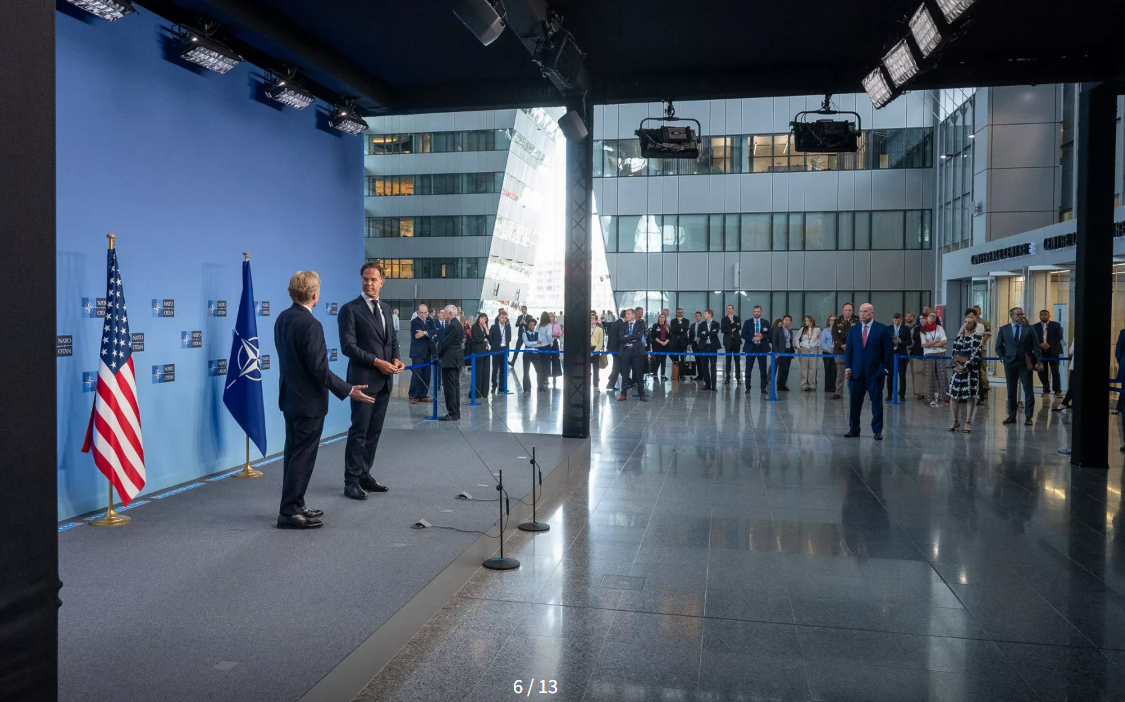
Some key NATO members were not invited to a meeting of the alliance in Poland on October 6. Among them are France, Great Britain, and the Baltic states. The view held by Elbridge Colby—the Under Secretary of war for Policy —is that NATO states which have not aligned their policies with Washington’s priorities should not be considered reliable allies.
On October 6, a gathering of NATO members started in Poland. The main event is the discussion of of the future development of the alliance, which is to be followed by two expert conferences, one of them on NATO infrastructure. However, not all the member-states will get an opportunity on the NATO strategy and, means of its implementation. Some of them were not invited. Among them France and Great Britain, which possess nuclear weapons, as well as the Baltic states, on which territory American troops are deployed as a part of the Eastern NATO’s flank joint defense.
It was the idea of Under Secretary of war for Elbridge Colby to deal with members of NATO depending on their willingness to comply with the approach of the US administration. The governments that have not aligned their policy with the priorities of Washington should not be regarded as trusted allies. Those that are `meeting American demands should be included in the inner circle and their opinion should be counted.
Colby, who has been allowed to carry out his initiative, held a first meeting with the six most favored NATO allies Bergen, Norway, in June. The Bergen Group formed at this meeting includes Norway, Sweden, Finland, Poland, Germany and the Netherlands. Now, the US administration is considering adding Denmark to the exclusive club. It was invited to the current meeting, but might participate in the next one.
The NATO countries involved in the Bergen format insist that its existence is not going to rupture the alliance. They pretend to believe that the group intends to come up with ideas it will be bought to the full alliance for further discussion. There is little doubt that the US administration just does not need that. Of course Washington has no intention to withdraw the US from NATO, despite the threats of president Donald Trump during his first term. The US forces depend on NATO infrastructure, which, as the war against Iran has shown, can be used in accordance with the US plans, even if they are not supported by the most of the NATO states. Ramstein air base located in Germany aqone hosts more than twenty thousand US military aircraft movements per year. No substitute can be found. The US also depends on NATO intelligence and early warning capabilities distributed across Europe and the North Atlantic. Colby, who is in charge of the US defense strategy has noted recently that the main task of NATO is to give Europe more military capacity. Europe should be able to defend itself in order to diminish the necessity of the US military presence and the risk of the war between Russia and the EU countries.
Besides, Colby also insists on reviving Germany as a military power to contain Russia. If it can be achieved, the US administration will be able to get two advantages out of it. First, Germany will lose prospects of reemerging as the main importer and distributor of Russian oil and gas in Europe. Second, in that case, the US relations with Germany and Russia will be better than their mutual connections. Therefore, the US administration will be act as a mediator and manage the confrontation. Thanks to that, Washington will retain political control over Europe, without increasing expenditures on American military presence or involvement in European defense. It will the US an opportunity to focus its efforts on contend with China’s rise, which the incumbent US administration regards as the main geopolitical challenge. According to Colby’s vision shared by the whole Trump’s administration, the allies, which adhere to Washington’s wishes, should be able to count on American protection, and those that do not support U.S. interests should suffer consequences. There is no need to discuss NATO’s future with those who cannot be used in the American interests or does not want to be useful for the US.
A similar approach is used to all American allies, not only the NATO’s states. In August, Trump abruptly ordered to downsize annual joint military exercise with South Korea, because of its refusal to join the war against Iran. The main most important feature of the imperial ideology is the belief that national security must rest on relations of domination. That’s why Trump officially revived the Monroe Doctrine and wants to reassert the US dominance in the Western Hemisphere.
On September 21, a day before his speech at the UN General Assembly, Trump published a picture in his Truth Social network, in which he looks at the Western Hemisphere on the globe. The picture is signed “His Hemisphere”. This publication provoked such fierce reaction that the US president found it necessary to repeat the publication in several days to show that the international outcry had no impact on him. President of Brazil Lula da Silva, who spoke just ahead of Trump, stated that “renewed hegemonic temptations” pose a threat to Latin America and the Caribbean. He added that “Brazil does not fit in anyone’s backyard” and needs “partners with a positive agenda that fosters development”, implying that China’s offers look preferable.
The results of the first round of Brazilian elections held on October 4, showed that approach of Lula da Silva to the relations with US is not supported by the majority of the Brazilian society. The main Trump’s opponent in the region was surpassed by Flavio Bolsonaro, a son of the former president.
The vote margin between two main rivals is quite narrow, Bolsonaro received 47% of votes and Lula 45%. Therefore, the president still has a good chance to win in the second round. However, it should be taken into consideration that Flavio Bolsonaro can be regarded to a certain degree as a substitute to his father, Jair Bolsonaro, who was an ally of the US and remains a close friend of the incumbent American president. In July 2025, Trump even imposed 50% tariffs on Brazilian goods to make Lula stop prosecution of Jair Bolsonaro, who is still under a house arrest. But if he had been allowed to participate in the election, he could have been more successful than his son. So even in Brazil the idea of the US dominance in the Western Hemisphere is not generally rejected, to say the least. And Trump’s ambition to turn the US into empire that dominates on the global level cannot be fulfilled without securing that natural resources and trade routes in Latin America are controlled solely by the US.
As a result, Europe is not going to be in the main focus of the US foreign policy in the near future. A few days before the beginning of the NATO meeting in Poland, the Trump’s administration made a symbolic gesture to demonstrate it. Washington redirected tens of millions of dollars approved previously as military assistance for Slovakia and North Macedonia to Latin America. The same happened with the funds designated for the support of the Iraqi forces. They were also diverted to Latin America, though on September 30, the last American troops left Iraq, ending 23 years of US military presence. Meanwhile, Shia militias, which are defying government control, have not been disarmed. Iraqi government turned out to be incapable of doing it, despite pledges of prime minister Ali al-Zaidi. Now, Baghdad is going to depend on Tehran’s assistance in restraining Shia armed groups. The US funds allotted for the military assistance to Iraq were insufficient to make Shia militias relinquish weapons, but taking the money away the Trump’s administration wanted to demonstrate its complete unconcern about it. The failure in the war with Iran made it impossible for the US administration to increase control over the Middle East. Due to that, Washington sees no reason to spend effort on supporting American allies in the region, even if it means that Iran will get an opportunity to increase its influence. Donald Trump has also made clear that he has no intention to abandon a ceasefire the US reached with Houthis last year, after Yemen’s Shia armed movement captured captured strategic islands and coastal towns and disrupted Saudi oil export through Bab-el-mandeb Strait. The next US administration, even if it will be a Republican one, might not so easily withdraw from its commitments with the US allies as the current one. However, Europe and the Middle East will remain less important for the US than Latin America and East Asia.
Europe is losing its geopolitical and economic significance on the global level, maybe, for the first time in five hundred years. It has been caused by emerging other centers of global development, first of all in China, which are becoming European rivals. Besides, during “cold war” Europe was the main arena of confrontation between the US and the USSR. After the American victory, the US required assistance of its European allies in the globalization process, which was regarded as the way to strengthen Western dominance. However, the globalization has reached its limits without achieving this goal. Moreover, the US has to put more effort into retaining a leading position in the global political system. So the European countries cannot count on the strong American support any more.
Of course, Trump’s inability to recognize importance of the transatlantic partnership undermines both European and American influence in the world. However, a historic crisis relations between the US and the EU caused not only by the approach of the Trump’s administration, but also by objective reasons. They can be overcome, only if the EU helps Europe to regain its global significance.
First, through technological leadership in the spheres that have the strongest impact on the geopolitical situation. Trump believes that the US will secure its global dominance, if it wins the race against China in the development of AI systems. The US is commanding approximately 50% of worldwide AI compute power and producing the highest number of notable frontier AI models. China is trying to compete with the US for global influence by focusing on cost-efficient open-source models and hardware manufacturing. The only EU country that has a notable influence on the development of the AI systems is France. And in the other spheres that affect the international development, for instance in industrial robot deployments, situation is not much better.
Second, through defending and spreading worldwide the values on which the EU is claimed to be grounded. The outcome of elections in the Republika Srpska have shown once again the EU has failed this task even in the neighboring countries.
If Europe becomes less important on the global level, the EU will inevitably lose some of its social achievements and economic prosperity. However, there have still been no notable attempts to reverse dangerous tendencies.
Dmitry GALKIN
Komentari

Uncertain Fate of Wars in Ukraine and Iran: Trump Does Not Need Peaceful Solutions Before a Deal with China
BACKGROUND OF MIHAILO ZINČUK’S MISSION IN MONTENEGRO: Helped to be discovered
TRUMP’S AMERICA AND GLOBAL SUBJECTS: Europe Cannot Afford to Become Less Important
Izdvajamo
-
DRUŠTVO4 sedmiceTRIDESET PET GODINA OD NAPADA NA DUBROVNIK: Rat za zaborav
-
DRUŠTVO4 sedmicePACIJENTKINJE U BOLNICI, SUD BEZ DOKAZA DA JE PREPARAT BIO ŠTETAN: Botoks između suda i medicine
-
Izdvojeno4 sedmiceSUŠA I DVA RATA STVARAJU NESTAŠICU ŽITA: Na rubu globalne gladi
-
IN ENGLISH8 satiBACKGROUND OF MIHAILO ZINČUK’S MISSION IN MONTENEGRO: Helped to be discovered
-
IN ENGLISH8 satiUncertain Fate of Wars in Ukraine and Iran: Trump Does Not Need Peaceful Solutions Before a Deal with China
-
INTERVJU4 sedmiceGORAN ĐUROVIĆ, MEDIA CENTAR: EU, pa demokratija
-
Izdvojeno4 sedmiceEURO MODEL I POSLOVANJE CRNOGORSKE PRIVREDE: Svakom svoja glavobolja
-
INTERVJU4 sedmiceNATAŠA KANDIĆ, OSNIVAČICA FONDA ZA HUMANTIRANO PRAVO I NJEGOVA BIVŠA IZVRŠNA DIREKTORKA, KOORDINATORKA REKOM-A: Nezavisnost Kosova ne može biti ugrožena nijednom presudom